Review by Alistair Aird The squad of players that kicked off season 1990/91 were looking to do something that a Rangers team hadn’t achieved since 1935, namely win three successive league titles. This of course discounts honours won during World War II when Rangers won the Southern League six years in succession. Hateley, who had Coventry City, Portsmouth, AC Milan, Monaco and a goal against Brazil in the Maracana on his CV, had been pursued by Souness for several years as the Rangers manager sought his utopian strike partnership comprising a target man and a predator. In Hateley he most certainly had the former, but the England international would prove to be so much more than that over the course of his time at Rangers. Hateley scored the first league goal of the season, opening the scoring in a 3-1 win over Dunfermline Athletic at Ibrox. But Hateley, who had spent the best part of two seasons on the sidelines due to an ankle injury, struggled for form in the early weeks of the season. He wouldn’t score again in the league until November, and that attracted criticism from elements of the Rangers support. And Hateley’s cause wasn’t helped when Souness teamed him up with Maurice Johnston rather than the darling of the follow follwers, Ally McCoist. The opening day win over Dunfermline was followed by a 0-0 draw against Hibernian, a 3-1 win over Hearts and a 1-1 draw against Celtic at Ibrox. And Rangers completed an uneven start to the league campaign when they lost 2-1 against Dundee United at Tannadice. One of the United goals that afternoon was a spectacular own goal by Terry Butcher. It would be one of the last things the colossal Butcher did in a Rangers jersey. Four days later, he was dropped for the League Cup semi-final against Aberdeen. Butcher had been struggling since the World Cup with the effects of a knee injury and hadn’t found form in the opening weeks of the season. Clearly Souness felt that his captain – the cornerstone of the success in that era – wasn’t irreplaceable and after leaving him out against Aberdeen, he never selected him for the first team again. Butcher would leave to become player-manager of Coventry City in mid-November. The captain’s armband went to Richard Gough, and he led his side on a fine run that saw them drop points in just five of their next 21 league games. Johnston scored his first goal at Parkhead in that sequence of fixtures, lobbing Pat Bonner in a 2-1 win in November. McCoist got the winner, rounding Bonner after picking up a through ball from Hurlock after the ex-Millwall man had robustly dispossessed Stevie Fulton in the heart of the pitch. Victory or even a draw in the Granite City would have all but secured three-in-a-row, but a goal from the Dutch striker, Hans Gillhaus, threw the title race wide open. And when a much-changed Rangers side lost 3-0 at Parkhead three weeks later, they could feel the breath of the Dons on their necks. The successor for Souness was obvious, it had to be promotion from within. Assistant manager Walter Smith, up there alongside Woods, Butcher and Hateley as the best signing Souness made, was appointed, and he took charge for single goal wins over St Mirren and Dundee United. But Rangers would triumph in the face of adversity. Aberdeen passed up a couple of reasonable chances to take the lead before Mark Hateley rose imperiously above Alex McLeish to bullet a header into the net to score his first league goal since mid-February. After a ragged start to his Rangers career, Hateley had come to the fore, and his second goal of the game – he pounced on a fumble from Michael Watt in the second half – sealed the win. East Stirlingshire, Kilmarnock, Raith Rovers and Aberdeen were put to the sword en-route to the final. The quarter final against Raith featured a McCoist hat trick, an own goal from Butcher and spectacular 35-yard effort at the right end by the soon-to-be deposed Rangers captain. The Treble would once more prove elusive. Home wins over Dunfermline Athletic (2-0) and Cowdenbeath (5-0) set up an Old Firm quarter final at Parkhead. And it would prove to be a tempestuous affair. Ally McCoist was dropped from the squad for what Souness perceived to be a breach of discipline – he had attended the races at Cheltenham in the run up to the game – and as the game unfolded, FOUR players were ordered off by referee Andrew Waddell. Three of them – Hateley, Hurlock and Walters – wore blue jerseys. Celtic won 2-0 but would lose 4-2 against Davie Cooper’s Motherwell in the last four. Rangers also fell short in their quest to win the European Cup. Maltese minnows Valletta were thumped 10-0 on aggregate. After a sun-drenched 4-0 win in Malta, Chris Woods tugged a penalty wide of the goal in the second leg at rain-soaked Ibrox. Maurice Johston scored a hat trick. But in the next round, Rangers met one of the finest sides of that era, Red Star Belgrade. With Robert Prosenecki and Darko Pancev at their disposal, Red Star comprehensively won the first leg 3-0 in Yugoslavia which rendered the second leg a formality. McCoist’s header that equalised a volley from Pancev was nothing other than a consolation. Season 1990/91 also witnessed the long awaited first team return of Ian Durrant. He had had a couple of aborted comebacks in the reserves since that horrific tackle at Pittodrie in October 1988, but the match against Hibernian at Ibrox on 6 April 1991, 916 days after sustaining the knee injury, was the first time that he tugged a blue jersey over his head for the first XI. He would score his first league goal since 17 September 1988 a week later in a 3-0 win over St Johnstone.
The group that had retained the title for the first time since 1976 was bolstered by the arrival of Pieter Huistra, a Dutch winger, and hardman midfielder, Terry Hurlock. But the blue-chip signing was Mark Hateley.
McCoist also scored two magnificent goals at home against Aberdeen in December, but Jim Bett did likewise to earn the visitors a 2-2 draw. But that would be the only point spilled in a run of 13 wins in 14 games which gave Rangers a commanding seven-point lead at the top of the table ahead of a trip to Pittodrie at the start of what would be a mad March.
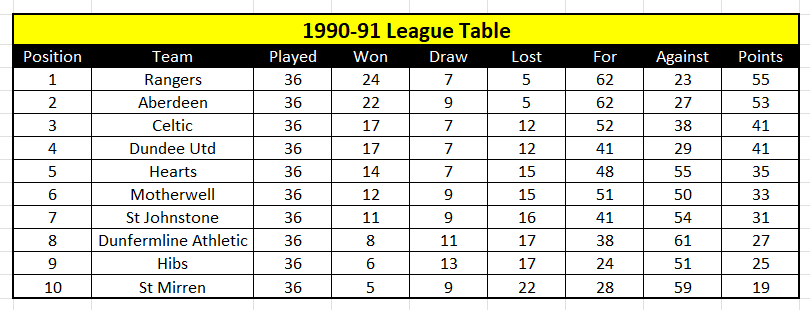
Managed by Alex Smith, Aberdeen responded to a 1-0 defeat at Parkhead on 19 January by embarking on a run in which they dropped just a single point in 12 games. And when they defeated St Johnstone 2-1 on the penultimate weekend of the season, that coupled with Rangers losing 3-0 at Fir Park edged Aberdeen ahead on goal difference. A draw at Ibrox on the final Saturday of the season would be enough to secure their first title since season 1984/85.
By the time the showdown came around, Rangers were under new management. Despite telling the Rangers News that he would never leave Ibrox, Souness couldn’t resist when offered the chance to succeed Kenny Dalglish as Liverpool manager. With four league games to go, the timing was far from perfect and Souness is said to have offered to stay in post until the conclusion of the season. But David Murray, who told his friend that he was making the biggest mistake of his life, insisted that the move happened there and then.
But a missed penalty from Mark Walters and two late goals from Motherwell’s Dougie Arnott in the second last league game threw the proverbial cat among the pigeons. Smith’s charges needed to win at home against Aberdeen or else his managerial tenure was going to get off to a less than auspicious start.
Smith had to patch up a broken side too. Richard Gough was absent as he had contracted Hepatitis A – Nigel Spackman captained the side – and John Brown was only able to play after taking an injection in his Achilles. It would eventually rupture in the second half and young Tom Cowan broke his leg too. That meant subs Durrant and McCoist, who were barely fit enough to raise a gallop, were called upon.
The League Championship trophy was joined on the Ibrox sideboard by the League Cup.
Goals from Mark Walters and Paul Elliot forced the Old Firm final into extra time. And perhaps it was fitting that in is first final as Rangers captain that Gough poked home the winning goal. Rangers had thus won the League Cup for the fourth time in five seasons.