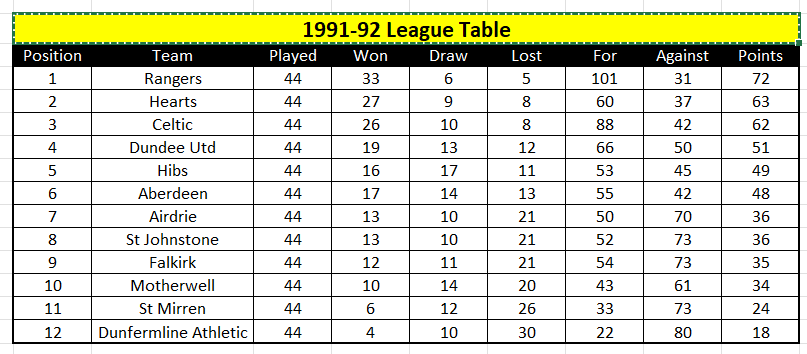
Written by Alistair Aird Walter Smith entered his first full season as Rangers manager but did so with shackles on. UEFA had introduced a new ruling that meant clubs competing in a European competition were only permitted to three foreign players to be listed in a matchday squad. That included players from England. Given the cosmopolitan nature of the Rangers first team squad, Smith found himself on the horns of a dilemma. He would need to scour the country for the best Scottish talent available while making some of the players who had played a pivotal role in the success the club had had since their rebirth in 1986 surplus to requirements. Smith’s first three recruits were stellar. Andy Goram came in from Hibernian, David Robertson arrived from Aberdeen, while Stuart McCall crossed Hadrian’s Wall after leaving Everton. Each of them would become mainstays during Smith’s tenure and form the nucleus of a side that would continue to dominate. Unfortunately, their respective arrivals signaled some significant departures. Chris Woods, who had finally managed to supplant Peter Shilton as England’s number one, wasn’t going to hang around and be number two behind Goram. He joined Sheffield Wednesday. Mark Walters also left to hook up with Souness at Liverpool. And not long after the season started, Trevor Steven was off to join Olympique Marseille for a fee of circa £5,500,000. Bonni Ginzburg and Terry Hurlock also exited Ibrox. Joining that trio on the road out of Ibrox were some of the Scottish contingent too. Stuart Munro, his path to the first XI likely to be barred by the arrival of Robertson, joined Blackburn Rovers, Tom Cowan went to Sheffield United and Neale Cooper signed for Reading. The season started with a thumping 6-0 win over St Johnstone. Hateley scored a hat-trick. A second successive home win followed – 2-0 against Motherwell – before Goram was caught out by a looping long range shot in a 1-0 defeat at Tynecastle. The man who would go on to stake a claim to be the club’s greatest ever goalkeeper didn’t have the best of starts to his Rangers career. In addition to that goal against Hearts, Goram fumbled a backpass from Scott Nisbet into the net as Rangers exited the European Cup at the first hurdle and the finger of blame could have been pointed in his direction too for the goal that took Hibernian to the League Cup Final. But those errors would soon be forgotten as Goram showed all and sundry exactly why Smith had earmarked him as the man that would thwart opposition forwards on a regular basis. It would prove to be a landmark moment for McCoist. Benched for most of the previous season under Souness, McCoist would rarely be out of the starting XI. By the end of the season, his 34 league goals marked him out of the top goalscorer across Europe and earned him the Golden Boot. McCoist’s return to the team meant the end of the road for Maurice Johnston. With Hateley and McCoist fusing together what would become a formidable partnership, Johnston was not content to bide his time like McCoist had done. In November, he went south and signed for Everton. Smith’s side took time to gel. Four of the first 20 league matches were lost – two of them at home against Aberdeen and St Mirren – and three were drawn. But in the 24 matches that followed – the league had been expanded to 12 teams meaning 44 league fixtures for the first time season 1987/88 – Rangers only dropped points in four of them, draws against Airdrie, Aberdeen and Hearts and a solitary defeat against Celtic at Ibrox. That loss on 21 March would be the last time Rangers would lose a league game at Ibrox until 28 August 1993. Highlights in that run of games were wins at Pittodrie and Parkhead. Rangers travelled north to the Granite City on 4 December and Mark Hateley was at his terrorising best. He opened the scoring with a stunning volley after five minutes and after Aberdeen had drawn level, he turned on the afterburners to outpace the home defence and give Rangers a 2-1 half-time lead. Hateley then carved out the opening for McCoist to lob in a third. But Brian Irvine halved the two-goal deficit and in a frantic finale, Rangers were indebted to Goram who produced an outstanding save to keep out a shot from Ian Cameron. Goram proved hard to beat in the east end of Glasgow on 1 January too. Rangers won 3-1 – McCoist and Hateley, the latter from the penalty spot, and a late John Brown daisy cutter made the difference – but Goram made a statement of intent with fine stops to deny Gary Gillespie, Stuart Slater and Paul McStay. It would not be the last time that the Rangers goalkeeper broke Celtic hearts either. Hearts proved to be the closest challengers for the title and the pivotal match came on 1 February. Rangers arrived in Edinburgh two points better off than their opponents and by 4.45, they had doubled that advantage. Robertson’s long throw was flicked on by Dale Gordon – ‘Disco Dale’ had come in from Norwich City in November and scored twice on his debut against Dunfermline Athletic – and when the ball broke to McCoist, he thundered a volley into the roof of the net to register goal number 26 of the season. He should have racked up number 27 too, but he contrived to spoon a shot wide of a gaping goal late in the game. Smith’s side never looked back. Four in a row was sealed with three games to spare when St Mirren were thumped 4-0 at Ibrox. McCoist scored twice, with a Gary Stevens piledriver and a strike from Pieter Huistra added into the mix. All that was left was to hit the 100. Going into the final day of the season, Rangers had registered 99 league goals. And it was no surprise that Scotland’s Player of the Year, the effervescent McCoist, was the man that grabbed the goal. In fact, he scored two splendid goals that afternoon as Aberdeen were beaten by two goals to nil. Rangers finished nine points clear of Hearts. With a mere 31 goals conceded, the goal difference was +70. Goram, an ever-present, kept 20 clean sheets. McCoist scored 34 goals in 38 league appearances. For the first time since 1981, the Scottish Cup returned to the Ibrox Trophy Room. A McCoist goal was enough to edge out Aberdeen at Pittodrie before the Cup holders Motherwell were beaten 2-1 at Ibrox. St Johnstone succumbed 3-0 in Perth in the last eight which set up an Old Firm semi-final, a fixture that is now regarded as one of the most significant matches of Walter Smith’s managerial career. At a windswept and rain-soaked Hampden, Rangers were a man down after only six minutes. David Robertson’s robust body check on Joe Miller was deemed worthy of dismissal in the opinion of the referee Andrew Waddell. A yellow card should have sufficed, but suddenly Rangers had their backs to the wall. But they showed gallantry and fighting spirit to lead at the break – McCoist giving another masterclass in clinical finishing – and to fend off wave after wave of attacks during a second half onslaught from Celtic. It was the night that a team was born. Airdrie provided the opposition in the final and it was left to the season’s golden couple to make the difference. Hateley opened the scoring with goal number 23 of the season and McCoist made it 2-0 before the interval with his 39th. Andy Smith set hearts aflutter late on when he volleyed the ball beyond Goram, but Rangers held out. Hibernian ended hopes of a fifth League Cup in six seasons. Keith Wright got the only goal of the semi-final at Hampden. And after overturning a 1-0 first leg deficit thanks to a brace from Stuart McCall, Rangers lost a goal that was a comedy of errors to exit the European Cup on away goals at the hands of Sparta Prague. But those two defeats would be the only pockmarks on an otherwise perfect first full season as Rangers manager for Walter Smith. If there were any dissenting voices over the wisdom of his appointment when he succeeded Souness in April 1991, they had long since been stilled. One of the most successful eras in the club’s history had begun in earnest.
A Hateley double secured both points in the campaign’s first Old Firm game at Parkhead, and the following midweek, Ally McCoist volleyed in the winner in the last eight of the League Cup against Hearts at Tynecastle.