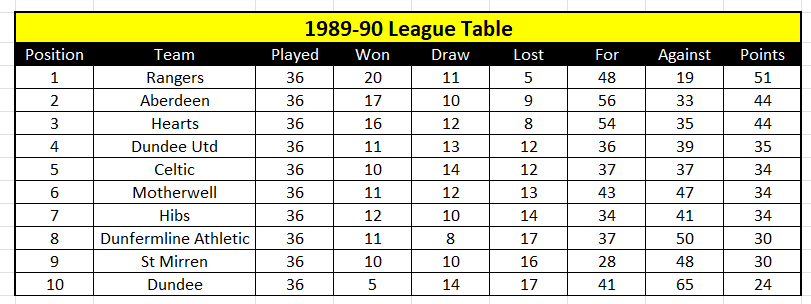
Review by Alistair Aird 10 July 1989. The day that the footballing Richter scale was off the charts. Events didn’t just cause a rumble in the Parkhead jungle, they shook the very bedrock of Scottish Football. Rangers had long been pilloried for a perceived aversion to signing Roman Catholic players. But Graeme Souness had been intent on bucking that trend. He had tried to no avail to sign Ray Houghton and John Collins, but a chance meeting with the football agent Bill McMurdo set in motion a chain of events that would culminate with furor on both sides of the Old Firm divide. It seemed set in stone. Maurice Johnston was leaving Nantes to sign up for a second spell with his beloved Celtic. He was even paraded at Parkhead in a green-and-white hooped jersey. But all was not as it seemed. No ink had found its way onto a contract, the deal had not been sealed. And when he got wind of this, Souness swooped to snare a world-class centre forward to help score the goals that would keep his Rangers side at the forefront of the Scottish game. After making public appearances in friendly matches against Airdrie, Kilmarnock and Partick Thistle, Johnston donned a blue jersey at Ibrox for the first time when Rangers defeated Tottenham Hotspur 1-0. Trevor Steven, the other major signing of the summer, netted the only goal. But Johnston and Rangers’ league campaign would get off to an inauspicious start. The opening two league games were lost – 1-0 against St Mirren and 2-0 against Hibernian – and Johnston would miss several chances to score in game number three, a 1-1 draw against his old club, Celtic, at Parkhead. Souness was scathing after that one, apportioning blame to McCoist and Johnston. ‘Some bad finishing by Scotland’s strike force cost us the game,’ was the opinion of the Rangers manager. He had a point too. In those eight league games, Rangers scored just six times. McCoist had grabbed three, Johnston two and captain Butcher the other. This was not in the script. But the defeat in Lanarkshire would be a turning point. It was followed by five straight wins, and when Johnston scored a last-gasp winner against Celtic at Ibrox on 4 November, Rangers were top of the table. There would be a wobble at Pittodrie 18 days later, but that was followed by an 15-match unbeaten run that saw 24 out of a possible 30 points gained. That sequence witnessed a 1-0 win at Parkhead – the recently acquired Nigel Spackman got the goal – and a 3-0 victory over Dunfermline Athletic at Ibrox. The tail end of the unbeaten run had featured four successive draws. Ahead of the first of them – a 1-1 draw at Fir Park – Rangers led second-placed Hearts by seven points. But when the run was ended by a 1-0 home defeat against Hibernian, the gap had been reduced to five points – Aberdeen were now the closest challengers – with six games to go. The popular opinion was that Rangers were rocking. But on 1 April, they allayed any fears their fans may have had that they would fall at the final furlong. Celtic came to Ibrox for the fourth and final Old Firm league match of the season. They did so in fourth place on the league ladder, nine points adrift of Rangers having won only 10 of their 30 league matches. And on April Fool’s Day, they were made to look foolish by a rampant Rangers side that won convincingly by three goals to nil. Mark Walters opened the scoring from the penalty spot after Anton Rogan had inexplicably handled in the box. Johnston made it 2-0 with a volley after being teed up by McCoist, and unlike his goal back in November, this one came in front of the Celtic fans congregated in the Broomloan Stand. And McCoist completed the rout with the third goal, emphatically ramming his penalty kick into the top corner. The title was secured at Tannadice just shy of three weeks later. Stuart Munro fired in a cross with his right foot and Trevor Steven thumped a header into the net. The clean sheet was the nineteenth of the league campaign, and number 20 arrived a week later in a 2-0 win over Dunfermline Athletic. Much of the focus had been on the goals scored by Johnston and McCoist, but the stoicism of the defensive unit was also a major contributory factor in the retention of the championship. Only 19 goals were conceded in the 36 league games, with Dundee (twice) and Hibernian the only teams that managed to score more than once against Rangers in a league fixture. Stuart Munro, the epitome of an unsung hero, played in each of the 45 first-team matches that season. After several attempts to replace him at left back – Jimmy Phillips and Jan Bartram being two examples of players Souness had signed to play in that position – Munro showed the manager that had no need to look elsewhere for he already had a solid, dependable and very capable full back at his disposal. After losing out in two successive epic League Cup Finals, Aberdeen won Part 3 of the trilogy. Paul Mason and Mark Walters scored in the regulation 90 minutes to force extra time, although Rangers were unfortunate to see efforts from Johnston and Steven cannon off the woodwork. But the spoils of victory would go to the men clad in red when Mason scored his second goal of the game seven minutes from the end of extra time. The Dons won the Scottish Cup too, beating Celtic 9-8 on penalties. Celtic had eliminated Rangers in Round Four – writing in the Evening Times, Alan Davidson said of the 1-0 loss: ‘Rangers can dismiss the defeat as little other than a hiccup on their way towards membership of Europe’s elite’ – but defeat at Hampden coupled with a semi-final loss to Aberdeen in the League Cup and a fifth placed finish in the league – Celtic finished 17 points adrift of Rangers – meant the first of what would be five trophyless seasons for the men in green and white. In that timeframe, still punch drunk from losing out on Johnston, Celtic would contest only one major Cup Final – they lost 2-1 to Rangers in the 1990/91 League Cup Final – and finish third in the league three times and fourth on the other occasion. Rangers’ dalliance in the European Cup was a brief one in season 1989/90. Drawn against Bayern Munich in the opening round, they were outclassed in the first leg at Ibrox, losing 3-1. A 0-0 draw in Munich a fortnight later could therefore be filed under ‘academic’. Lessons needed to be learned from that defeat as that was where focus was shifting. Souness had got Rangers back to the pinnacle of the Scottish game. They were flexing their muscles and dominating. As witnessed by the two Cup defeats, any team could beat them on their day, but Rangers were now far too strong to be challenged over the course of a marathon league campaign. The pursuit of European glory would thus be the next step. Souness had won the European Cup three times as a player, now he wanted to add the continent’s premier club trophy to his managerial CV. Alas, this would be one mission that would prove to be impossible.
The elusive first goal did eventually arrive on 9 September when Johnston rose to meet a cross from Trevor Steven and direct a header into the net during a 1-0 win over Aberdeen at Ibrox. He would score the only goal of the game at Ibrox again three weeks later – Hearts were beaten on that occasion – but a 1-0 defeat at Fir Park on 3 October meant that Rangers had won just two of their opening eight league fixtures.
That match would be emotionally charged as it would be the last time Ray Wilkins would play a competitive game for Rangers. ‘Razor’ had been a breath of fresh of air since arriving from PSG a couple of years earlier and the high regard he was held in by fans and players alike was very much reciprocated. Wilkins loved his time in Glasgow, but the lure of London proved too much to resist. He signed for QPR but only after signing off with a sumptuous assist for the first goal of his final game, a magnificent, lofted pass over the top of the defence that tucked away by Johnston.
The league championship was the only silverware netted by Rangers in season 1989/90.