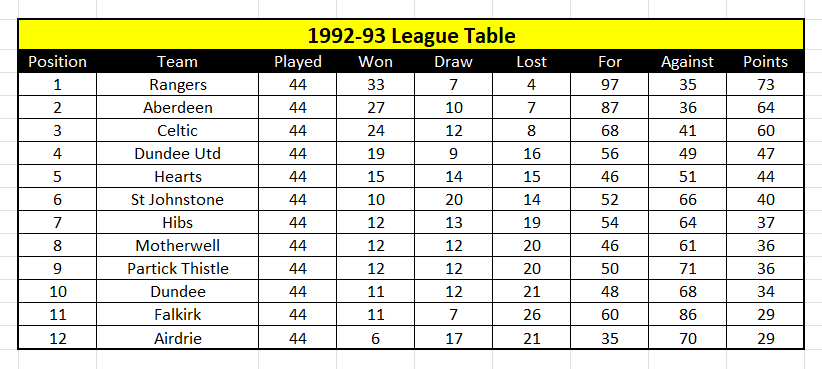
Written by Alistair Aird Going into season 1992/93, Rangers were on a roll. After going nine years without a league title, they had won five of the last six. The League Cup had almost been a permanent fixture on the Ibrox sideboard, and an 11-year Scottish Cup hoodoo had been busted too. The Double-winning squad was bolstered with three additions. Ally Maxwell, a Scottish Cup winner with Motherwell, came in to provide back up for Andy Goram, Dave McPherson, who had become a Scottish international after leaving Rangers for Hearts in the summer of 1987, came back to Ibrox for a second spell, as did Trevor Steven, who returned from the south of France after less than a year away. Departing for pastures new were strikers John Spencer and Paul Rideout. Both had found it impossible to supplant McCoist and Hateley so moved on. Both would flourish too, with Spencer thriving at Chelsea and Rideout going on to score the winning goal for Everton in the 1995 FA Cup Final. For the second successive season, St Johnstone were at Ibrox when the curtain for the new campaign was raised. But on this occasion, there would be no romp like there had been 12 months earlier. Instead, it took a solitary McCoist goal to earn a 1-0 win. Goals from Gordon and Hateley earned a 2-0 win over Airdrie, a result that preceded a brief hiccup. There was a goalless draw at Easter Road before a Simon Stainrod-inspired Dundee created an unexpected bump in the road. Rangers lost 4-3 at Dens Park, but that would be the last time a Rangers side would endure the bitter taste of defeat until March, a run of 44 matches unbeaten in all competitions. Ian Durrant scored to earn a share of the spoils in the season’s first Old Firm league match and that was followed by 11 successive league wins. McCoist scored 18 times in that run which included two hat tricks against Motherwell and four goals against Falkirk. Riding the crest of a wave, McCoist wore the captain’s armband too, deputising for the injured Richard Gough against Dundee United at Tannadice and in that 4-0 win over Falkirk at Ibrox. A win over Partick Thistle was sandwiched between draws at Tynecastle and Broomfield, the latter being followed by eight straight wins. Included in that run was a 1-0 win over Celtic on 2 January. Trevor Steven scored the goal with a fine header. The unbeaten run would eventually come to a halt at Parkhead on 20 March. Celtic won 2-1 in a match that would prove to be the last time Scott Nisbet played for the Rangers first XI. Aged just 25, his career would be ended by a pelvic injury. Across all four competitions, Rangers were unbeaten in 44 games. That comprised four League Cup ties, three matches in the Scottish Cup, eight in the European Cup/Champions League, and 29 in the league. Of those 44 matches, only eight were drawn. A fifth successive title was sealed with four games to spare courtesy of a 1-0 win over Airdrie at Broomfield on 1 May. And even though Rangers lost two of those final four games, they still finished nine points better off than runners-up Aberdeen. Sixteen goals were scored as Dumbarton, Stranraer, Dundee United and St Johnstone were swatted aside en-route to the League Cup Final. Rangers had thus contested 10 of the last 12 finals in the competition. In the other two campaigns – 1985/86 and 1991/92 – they had lost in the semi-finals, ironically against Hibernian on both occasions. Aberdeen provided the opposition at Hampden and Rangers would profit from a recently introduced ruling. Goalkeepers were no longer allowed to handle a backpass from one of their own players so when the ball spun towards Theo Snelders from an Aberdeen boot, the Dutch keeper elected to try and control the ball with his chest. But it bounced back into play and Stuart McCall devoured the rebound. Duncan Shearer struck in the second half to force extra time, but Rangers would edge it in the extra half hour. Robertson’s searching cross was aimed towards Hateley, but Gary Smith got on the end of it and sent a diving header beyond his own goalkeeper. The Dons would be runners up in the Scottish Cup Final too. Rangers didn’t have a home draw in the competition, as they defeated Motherwell at Fir Park (2-0), Ayr United at Somerset Park (2-0), and Arbroath at Gayfield (3-0). The semi-final against Hearts was played at Parkhead. McPherson and McCoist scored the goals in a 2-1 win. McCoist’s goal – a lob over the outrushing Nicky Walker – was his 49th of the season. He would be denied the opportunity to hit the half century, though. On 28 April, McCoist was in the Scotland side that were drubbed 5-0 by Portugal in Lisbon. He sustained a broken leg that ruled him out for the rest of the season thus robbing him of the opportunity to become the first Rangers player since Jim Forrest in season 1964/65 to score more than 50 goals in one campaign. The leg break ruled McCoist out of the Scottish Cup Final. Played once again at Parkhead, Neil Murray opened the scoring before Hateley scored his 29th goal of the season to not only clinch the Cup but also the domestic Treble for the first time since season 1977/78. Home and away wins over Danish champions Lyngby set up a mouthwatering ‘Battle of Britain’ against Leeds United. Opposition supporters were excluded from attending the home matches and a partisan Ibrox was silenced within a minute of the first leg when Gary McAllister rifled a volley into the roof of the net. But voices weren’t stilled for long. The Leeds goalkeeper, John Luckic, flapped at a Durrant corner and punched the ball into his own net before McCoist, prowling like a predator in the six-yard box, rammed in the rebound after Luckic had parried a header from McPherson. Rangers thus had a slender lead to take to Elland Road a fortnight later. The English media felt that wouldn’t be enough, arrogantly predicting that Leeds would progress comfortably to the group stages of what was the inaugural Champions League. But that only served as motivation for Rangers. Archie Knox pinned the cuttings on the dressing room wall and that fired up the players. Hateley scored the ‘BFG’ – boot (Goram), flick (Durrant), goal (Hateley) – early in the game and then provided a sublime cross at the end of a flowing breakaway move to set up McCoist for the second. When McCoist’s diving header ruffled the net, silence descended. A late goal from Eric Cantona was nothing other than a consolation for Leeds. Although Hateley and McCoist rightly received the plaudits for their two terrific goals, man-of-the-match was Andy Goram. The Rangers number one had more than a few fine performances in his time at the club, but that night at Elland Road topped them all. He repelled almost everything that was fired at him by among others Cantona, Lee Chapman and Rod Wallace with only that late Cantona effort robbing him of the clean sheet his performance deserved. There were now eight teams left. They would be drawn together in two groups of four, with the group winners progressing to meet in the Final. Bracketed with Rangers in Group A were Marseille, Club Brugge and CSKA Moscow. The French champions were first up at Ibrox, and they looked to be coasting to a comfortable win when they led 2-0. But Rangers showed resilience. Gary McSwegan came off the bench to loop a header over Fabien Barthez and Hateley then stooped to head in the equalizing goal. A point had been gleaned from a match that at one point had looked like running away from Rangers. An Ian Ferguson goal secured a 1-0 win over CSKA Moscow in Bochum before Pieter Huistra struck to earn a 1-1 draw against Brugge. But then came the pivotal moment. Rangers led 1-0 in the home match against Brugge, Durrant slotting a sublime pass from Trevor Steven into the net. But as half time approached, Hateley got caught in a headlock by Rui Cossey. To free himself up, Hateley pushed the defender away. At worst it was a yellow card for both protagonists, but the referee decided to order Hateley off. He would now miss the vital match in Marseille through suspension. A memorable goal from Scott Nisbet secured a 2-1 win. Marauding forward, Nisbet’s attempt to cross the ball into the box spun up into the air and when the ball landed, it spun and evaded Danny Verlinden in the Brugge goal, and that set up a winner-takes-all joust with Marseille. In essence, whichever team won the match was in the Final. A sloppy clearance from Robertson created the opening goal for Marseille – Franck Sauzee was the scorer – but Rangers battled back and equalised when Durrant, who was magnificent in that campaign, fizzed a volley into the net. No further goals were scored which meant it was all or nothing in the final round of fixtures. After a gallant run, Rangers unfortunately came up short. Ally McCoist was unusually profligate in front of goal as Rangers drew 0-0 at home to CSKA Moscow while Marseille won 1-0 in Brugge. Future Ranger Basile Boli then netted the only goal in the Final against AC Milan. Season 1992/93 therefore joined 1948/49, 1963/64, 1975/76 and 1977/78 in the history books as Treble-winning campaigns. Only twice since then – 1998/99 and 2002/03 – have Rangers completed the clean sweep. That alongside that unforgettable seven-month unbeaten run is why this season is often picked out as being the finest of all the nine seasons that made up nine-in-a-row.
Rangers also came close to adding the European Cup to their array of seasonal silverware.