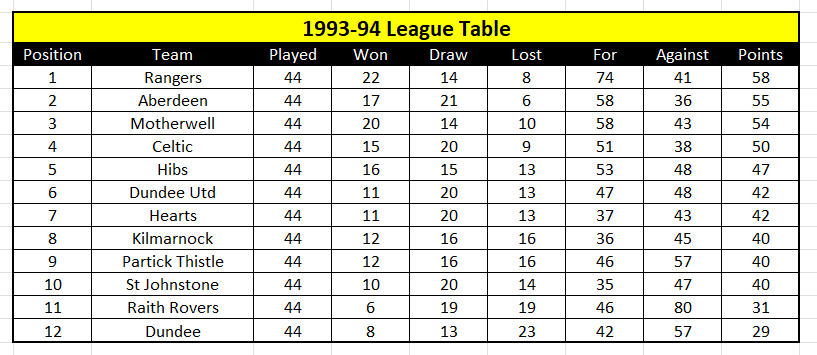
Written by Alistair Aird Although Walter Smith’s Rangers were dominant domestically as season 1993/94 commenced, they didn’t stand still or rest on their laurels. They smashed the British transfer record when they shelled out £4,000,000 to recruit Duncan Ferguson from Dundee United. One of the most talented young players in Scotland, Ferguson was viewed as the heir apparent to Mark Hateley. But his arrival would light a fire under Hateley who would embark on a stellar season that ended with 30 goals netted in 55 appearances. A combination of a knee issue flu and a hamstring injury accounted for Ferguson’s absence, and in total, he only started seven league games. But on one of those league starts, against Raith Rovers at Ibrox on 16 April, he got involved in an altercation with John McStay that would see him spend 44 days in Barlinnie. Ironically, he broke his scoring duck for Rangers in the same game. The league season started with back-to-back 2-1 victories over Hearts and St Johnstone before Rangers endured something of a sticky spell when they failed to register a league win in five matches. Three of them were drawn and of the two that were lost, the 2-1 defeat at home to Kilmarnock – former Rangers Bobby Williamson scored the late winner – was the first defeat at Ibrox since March 1992. What was perceived to be a decline wasn’t really arrested until December. Uncharacteristically inconsistent, Smith’s side dropped points in 12 of their opening 22 league games. Three of the five losses came at Ibrox, the last of them being a 3-0 thrashing at the hands of Dundee United. Rangers found themselves 3-0 up inside the opening half hour. Hateley opened the floodgates after less than a minute had elapsed and Mikhailichenko doubled the lead after four minutes. Commentating on the match for Sportscene, Jock Brown said that ‘you could have driven a bus through the Celtic defence’ after a pass from Gordon Durie played Neil Murray in on goal. Murray should have scored himself, but when Bonner blocked his shot with his foot, the ball fell to Mikhailichenko to ram into the empty net. The Ukrainian winger prodded the ball into the net again after 28 minutes. As the Rangers players celebrated a Celtic supporter entered the field of play and tried to attack Ally Maxwell. John Brown was on hand to help his goalkeeper before the invader was taken away by police. Hateley netted 10 times in that run of games, but his total was eclipsed by Gordon Durie who scored on 12 goals. Arriving in November from Tottenham Hotspur, Durie fitted in seamlessly and filled the gap left by Ally McCoist who was struggling to regain fitness after recovering from breaking his leg. By the end of the season, Durie would find the net 13 times in all competitions. The unbeaten run was ended by Motherwell and Rangers didn’t win any of their last five league games. But the job had been done by then. Although they had been ragged a little too often – only half of the 44 league games ended in victory - Rangers still managed to outmuscle their closest challengers, finishing the season three points clear of Aberdeen. The League Cup was retained too. Dumbarton and Dunfermline Athletic were beaten before Ian Ferguson scored the winner in a 2-1 win over Aberdeen in the quarter-final. And a solitary goal from Hateley edged out Celtic at ‘neutral’ Ibrox in the last four to set up a match against Hibernian at Parkhead in the Final. You had to go back to the Final in season 1982/83 to find a team other than Hibernian that had defeated Rangers in a League Cup tie. The Easter Road side had won the semi-final tie in 1991 and over two legs back in season 1985/86, their 2-0 win in Edinburgh being enough despite Davie Cooper giving Rangers hope back at Ibrox with a thumping free-kick. But they wouldn’t emerge victorious on this occasion. Ian Durrant scored a sublime goal to break the deadlock early in the second half, delicately lobbing the ball over Jim Leighton, and although Dave McPherson turned the ball into his own net to level the scores, the trophy would end up bedecked in red, white and blue ribbons. It is fair to say that Ally McCoist’s return from breaking his leg back in April 1993 hadn’t been as seamless as expected. He had barely featured for the first XI, but Smith felt he was fit enough for a place on the bench at Parkhead. And the wily old fox would be rewarded for that when McCoist, who looked to be carrying some extra timber, replaced Pieter Huistra. With nine minutes left, David Robertson hurled a long throw into the box. No one could get on the end of it and the ball spun towards McCoist. He had his back to goal, but managed to control the ball on his chest before executing a magnificent overhead kick that left Leighton clutching air. Super Ally had indeed done it again! Rangers were thus geared up for what would have been an unprecedented back-to-back Treble. Dumbarton, Alloa Athletic, Hearts and Kilmarnock were beaten on the road to Hampden, but on this occasion, the destination for the trophy wouldn’t be Ibrox. Dundee United had never won the Scottish Cup and had several failed attempts to do so under Jim McLean. But Ivan Golac’s side won 1-0, Craig Brewster tapping into an empty net after Ally Maxwell had made a mess of trying to clear a backpass from McPherson. Maxwell had been the number one goalie throughout the season. Injury restricted Andy Goram to just 10 appearances, but the error at Hampden wasn’t the only one Maxwell was guilty of. Back at Ibrox in October, he had been culpable for the loss of both goals in a 2-1 defeat against Celtic and there were other slip ups too. It is fair to say that he hadn’t convinced anyone that he had what it took to supplant the imperious Goram as the Rangers number one. There would be no European odyssey either. Rangers drew the Bulgarian champions, Levski Sofia, in the opening round, but a couple of careless mistakes saw the first leg at Ibrox end 3-2 in the favour of the boys in blue. But as the second leg drifted into stoppage time, Ian Durrant’s goal and a 1-1 scoreline looked to be enough to see Rangers through. Heartbreak followed. Nikolai Todorov rifled in a shot from distance, and it roared into the top corner. The soon to be maligned Maxwell was helpless. Having almost gone the distance the previous season, Rangers were sucker punched and knocked out in the opening round.
By contrast, Ferguson scored just once in 16 games. Admittedly, his season was curtailed by injury. Feguson arrived at Ibrox having not played in a league game for United since 9 April due to a hamstring injury. That meant his debut in a Rangers jersey was delayed until 21 August when Rangers drew 0-0 against Celtic at Parkhead. But he appeared in only four league games and two League Cup ties after that. And when he replaced Pieter Huistra during a 2-0 defeat at Pittodrie in mid-September, Ferguson wouldn’t play again for the first XI until he came on as sub for Gordon Durie in a 2-0 win over Hearts in the last eight of the Scottish Cup. That was on 12 March.
But just when the wheels of the bandwagon looked like they were wobbling, Rangers realigned, reset and got back on the glory trail. After losing to United on 11 December, they didn’t lose another league game until 26 April. In that run of 17 fixtures, points were spilled in just five of them.
The match that stood out above all others in that sequence came at Parkhead on New Year's Day.
John Collins reduced the deficit a couple of minutes into the second half, but another Ukrainian, Oleg Kuznetsov, put the result beyond any doubt when he rifled in a fourth goal with 14 minutes remaining.
In what was arguably the most ragged of all the nine-in-a-row seasons, Mark Hateley emerged as the main man. He missed only two league games, finding the net 22 times. He appeared in 55 of the 57 competitive matches Rangers contested, and although his scoring spree tailed off towards the end of the season – his last league goal came at Tynecastle on 26 March – Hateley was undoubtedly the talisman. With McCoist only starting 16 league games, it was down to Hateley and Durie to a lesser extent to shoulder the goalscoring burden. Hateley, with 30 goals in all competitions, was duly rewarded for his efforts when he was crowned Player of the Year by both the Scottish PFA and the Scottish Football Writers Association.