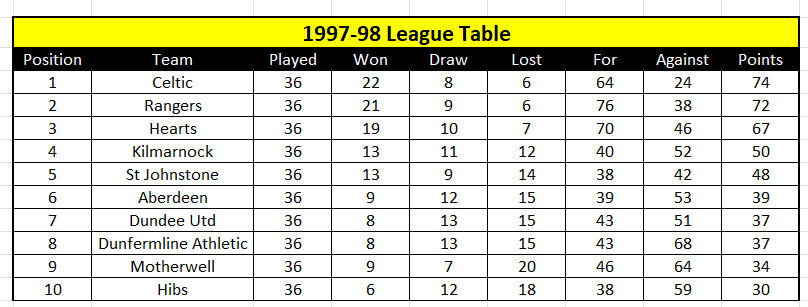
Words by Alistair Aird Having managed to match Celtic’s achievement of nine successive league titles the previous season, the sights of the Rangers squad were firmly fixed on securing an unprecedented 10-in-a-row as the new campaign dawned. And they would do so under the guidance of a new on-the-field leader. After almost 10 years at Ibrox, Richard Gough left in the summer of 1997 and headed to America to sign for Kansas City Wizards. Since taking over the armband from Terry Butcher, Gough had captained Rangers to seven league titles, four League Cups and three Scottish Cups. And over the course of nine-in-a-row, no one wore a blue jersey in a league game more often than Gough who had played in 263 of the 348 fixtures. Replacing Gough as skipper was Brian Laudrup. Rumours were rife that the Great Dane, Scotland’s Player of the Year, was set to leave Rangers, but he was convinced to stay and he was handed the responsibility of marshalling the troops and getting them ready for an assault on another league title. The squad was bolstered once again with an abundance of cash splashed to secure the services of four Italians – Lorenzo Amoruso, Marco Negri, Rino Gattuso and Sergio Porrini – and they were joined by Staale Stensaas, a Norwegian left back, and the Finnish goalkeeper, Antti Niemi. The Swedish midfielder, Jonas Thern, also came on board. Pre-season witnessed defeats at Goodison Park and Tynecastle and a thumping 5-0 win over Stirling Albion. The ‘Whites’ then thrashed the ‘Blues’ 6-1 when Rangers faced Rangers at Ibrox on a family day. Ally McCoist took great delight in scoring a hat trick for what was supposed to be the second XI. McCoist would, however, spend much of the first half of the season looking on from the sidelines as a moody Negri embarked on a red-hot goal streak. Negri followed up a brace in the opening league fixture against Hearts with all five goals in a 5-1 win over Dundee United. Indeed, he would find the net in each of the opening 10 league matches, his rich vein of form helping Rangers to seven wins and two draws in those fixtures. By 27 December, Negri’s league tally stood at 30 in just 19 games. But in the 17 that followed, he scored only three times. An eye injury sustained while playing squash was cited as a contributory factor for the loss of form. It could be argued that the injury also cost Rangers the title. With Amoruso ruled out of action for several months, Gough answered Walter Smith’s SOS. He crossed the wild Atlantic to come back to Scotland, his first match back witnessing four goals from Negri, a couple from Gascoigne and one from Laudrup as Dunfermline were thrashed 7-0 at Ibrox. Gough also netted the only goal in a 1-0 home win over Celtic. Over the course of the season, Gough would miss only five league games, but his return would not be a triumphant one. For the first time since he had been made captain, Gough would not end the season with his hands cupped around the league trophy. Rangers won 12 and drew six of their first 19 league games. The only defeat came at Tannadice in October. One of those draws was costly, though. At Parkhead in November 10-man Rangers – Gascoigne had been ordered off by referee John Rowbotham – led 1-0 going into stoppage time. After by his lofty standards a ‘barren spell’ of two league games without a goal, Negri’s rapier-like finish looked to have given Rangers a decisive edge. But an Alan Stubbs header rescued what would prove to be a precious point for Celtic. On their return to the east end of Glasgow on 2 January, Rangers lost 2-0, their first Old Firm league defeat since May 1995 and only their second reverse in the league that season. The momentum was starting to swing. Rangers won just three of their next eight games and then lost Gascoigne who was sold to Middlesbrough in March. Many felt that his departure gave Celtic the belief that they could pip Rangers at the post and win the league. McCoist was called upon to steady the ship. Before he scored in a 2-1 defeat at Fir Park in March, the veteran had started only one league game, ironically against Motherwell in late November. But he would feature in the final nine league matches, scoring four times. Alas, Amoruso, who had finally made his long-awaited debut in March, was ordered off in a 1-0 defeat at Pittodrie. And a similar scoreline against Kilmarnock at Ibrox in the penultimate fixture all but secured the title for Celtic. They beat St Johnstone 2-0 at home on the last day to finish two points ahead of Rangers. The season would finish with no silverware for the first time since season 1985/86. Hamilton Accies and Falkirk were beaten in the opening two rounds of the League Cup, but a goal from ex-Ranger Gary McSwegan earned Dundee United a 1-0 win in the quarter finals. The Accies were beaten once again in the Scottish Cup and wins after replays saw off both Motherwell and Dundee. McCoist and Albertz then scored to see off Celtic’s challenge in the last four, but Hearts would edge a controversial final by two goals to one. Europe would prove to be a disappointment too. After easing to an 11-0 aggregate win over GI Gotu, IFK Gothenburg emphatically ended hopes of group stage football in the Champions League. And after parachuting into the UEFA Cup, Rangers lost home and away against RC Strasbourg. The season ultimately marked the end of one of the most successful eras in the club’s history. Walter Smith had announced that he intended to step down as manager – he would be replaced at the helm by the Dutchman, Dick Advocaat – and totemic figures like Durrant, McCoist, Laudrup, Gough and Goram departed too. The group had shared so much success and silverware, but all good things must come to an end.
Among those nine games was what looked like the pivotal moment. On 12 April, Rangers defeated Celtic 2-0 at Ibrox. Thern lashed in the opener with a magnificent volley and Albertz sealed the points with a solo goal. There were only four games to go. Four wins would seal a tenth successive league title.
The Edinburgh side were awarded a soft penalty in the opening minute and Rangers were denied one of their own when Laudrup seemed to be felled in the box late on. This was after McCoist had come on to score and reduce a two-goal deficit to just one. It’s fair to say that it wasn’t referee Willie Young’s finest hour!