Dr Marshall 41
Torbet 71
Match Information
Attendance: 103,688
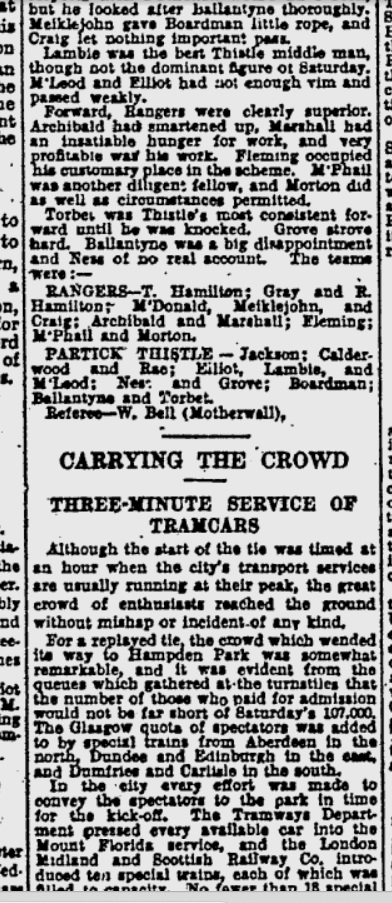
Referee: W Bell (Motherwell)
Matchday: Wednesday
Match Trivia
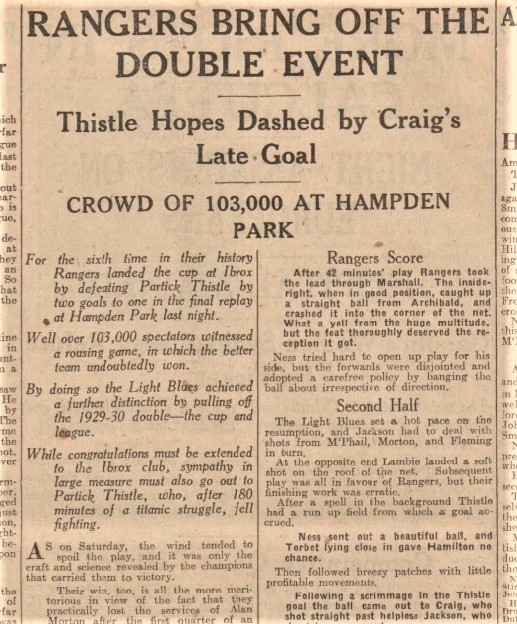
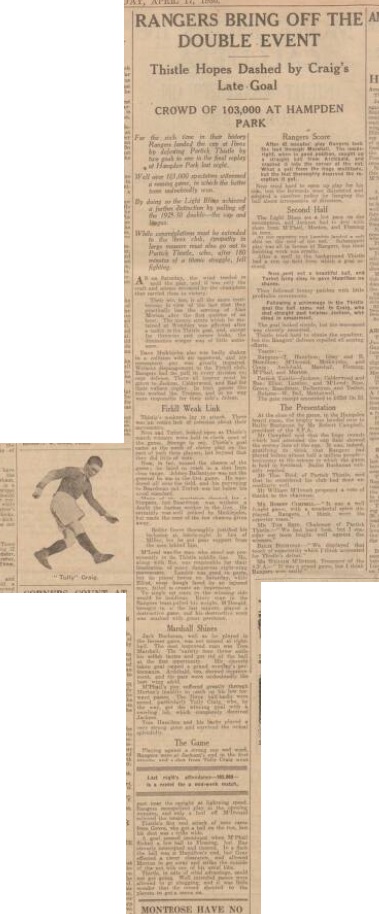
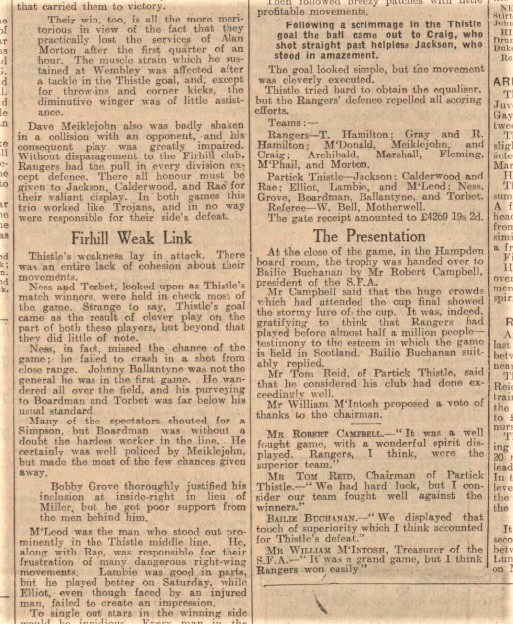
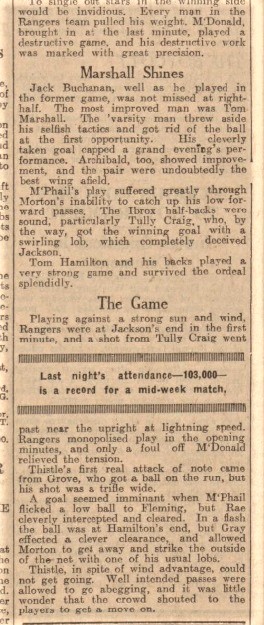
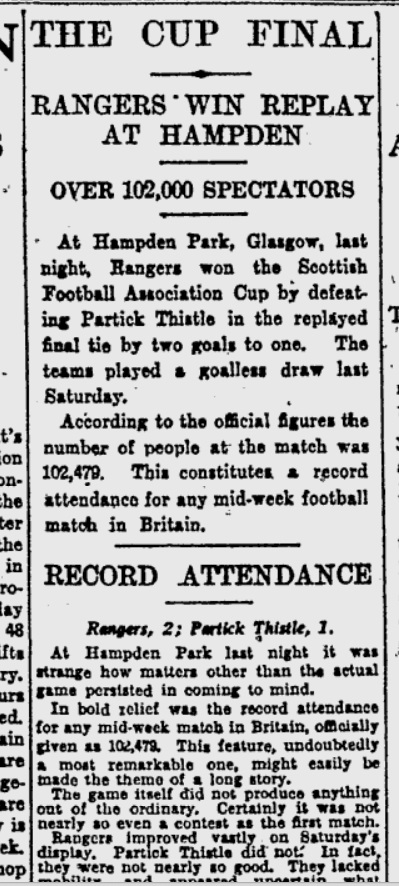
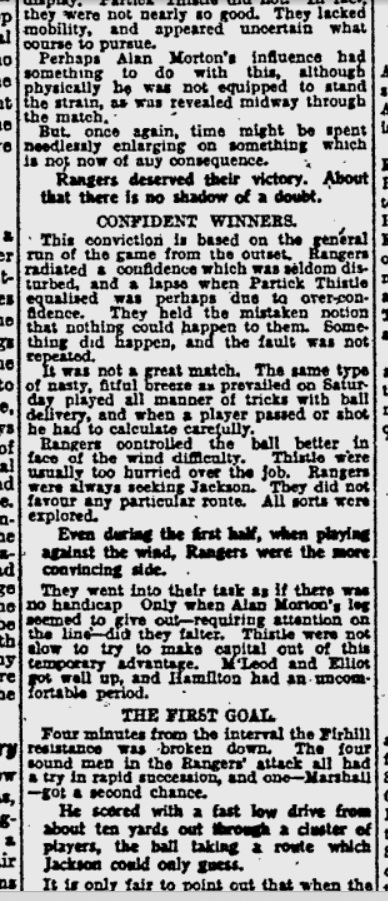
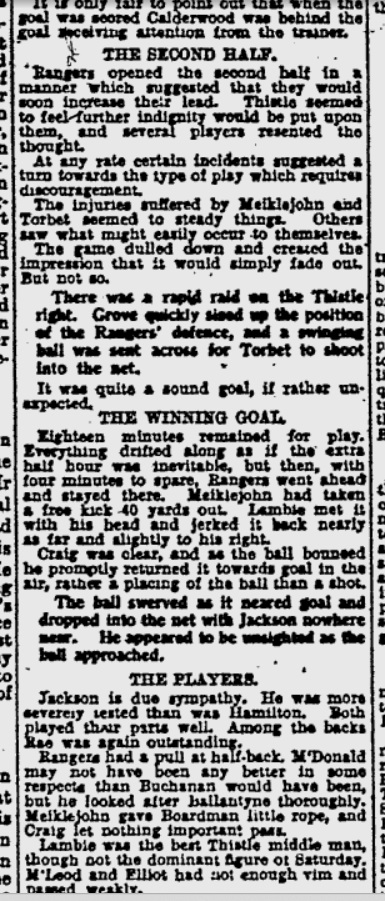
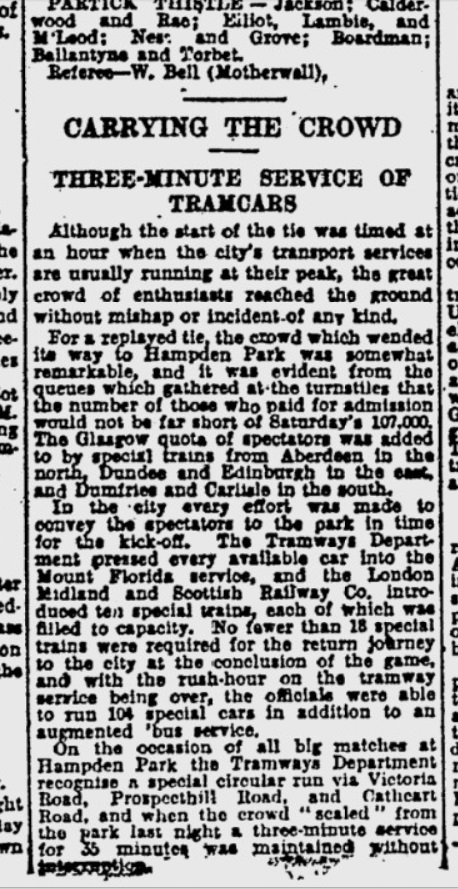
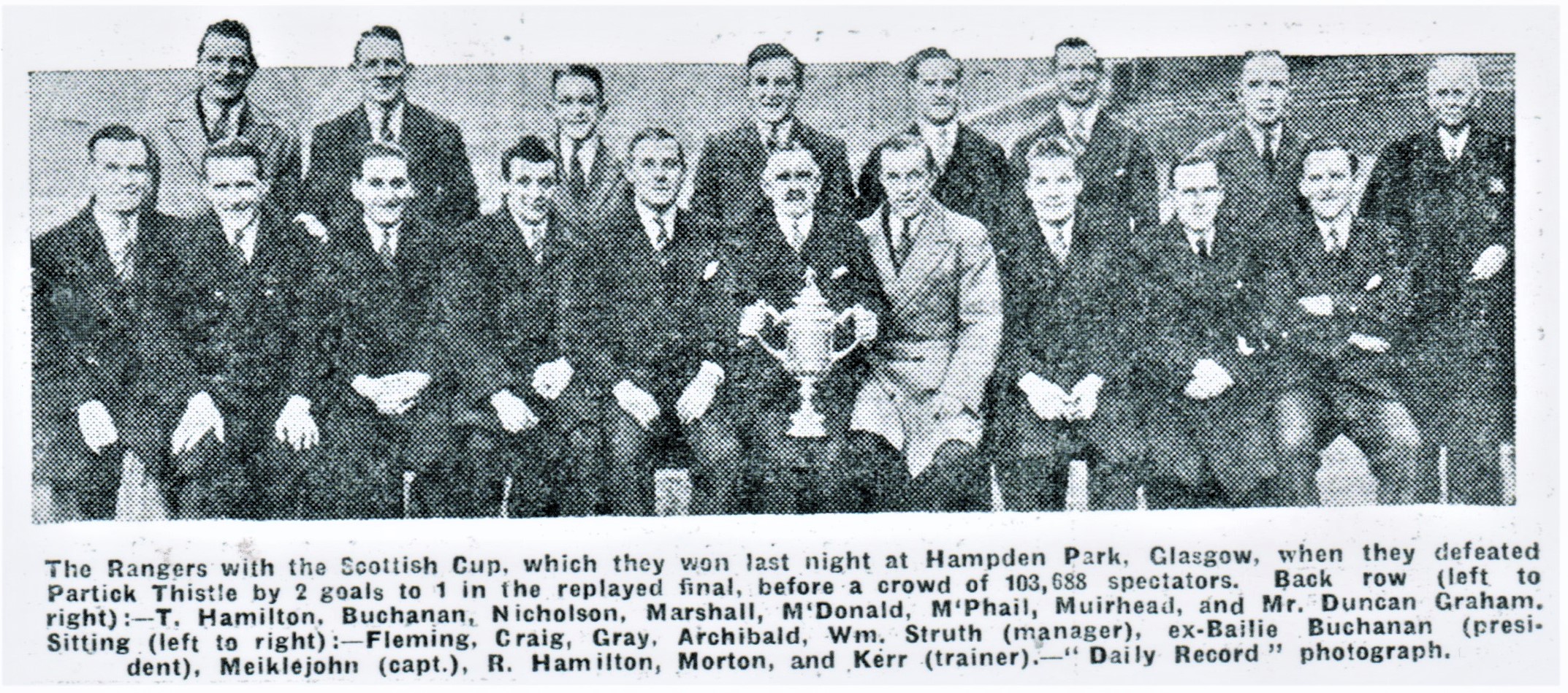
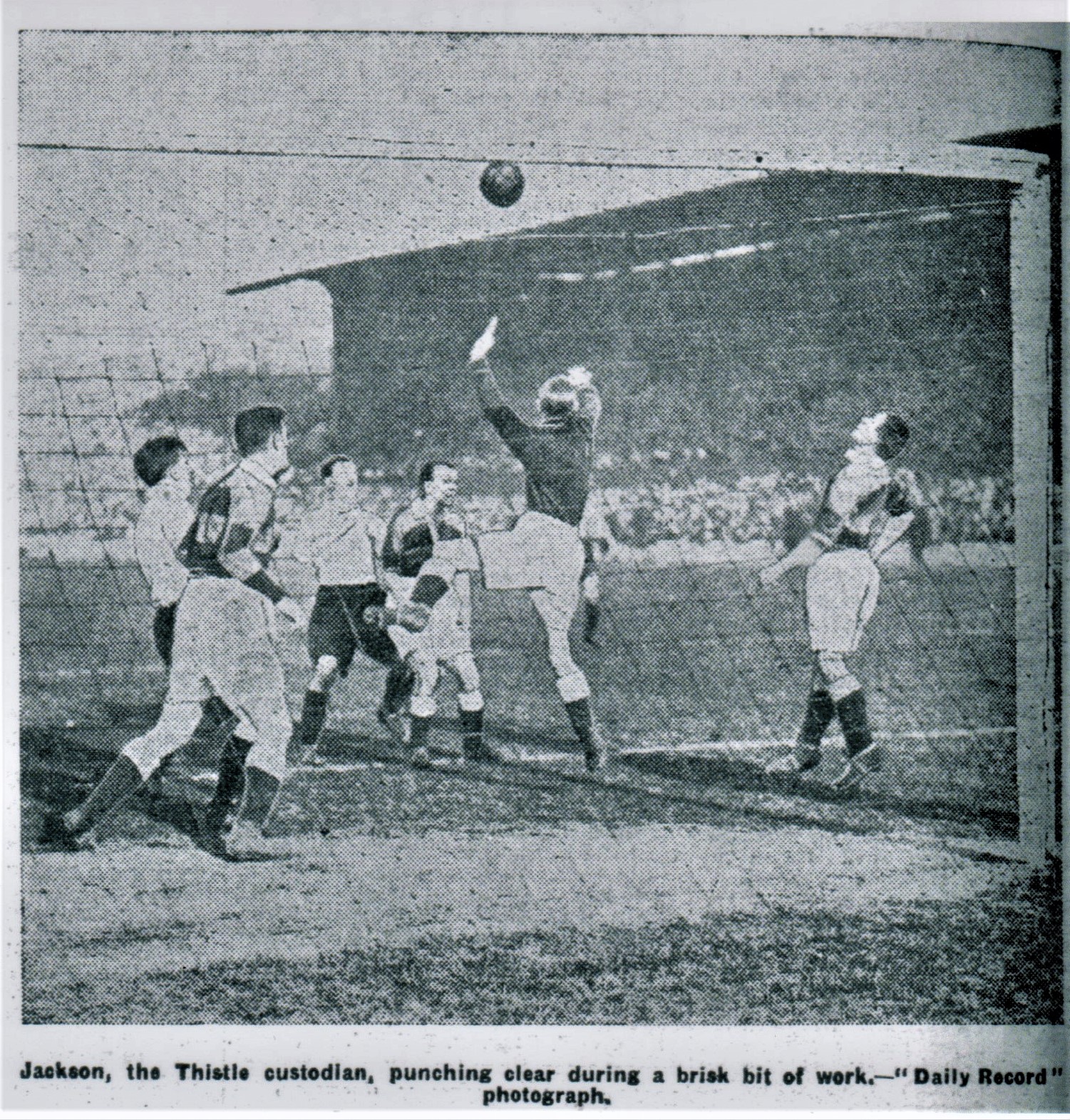
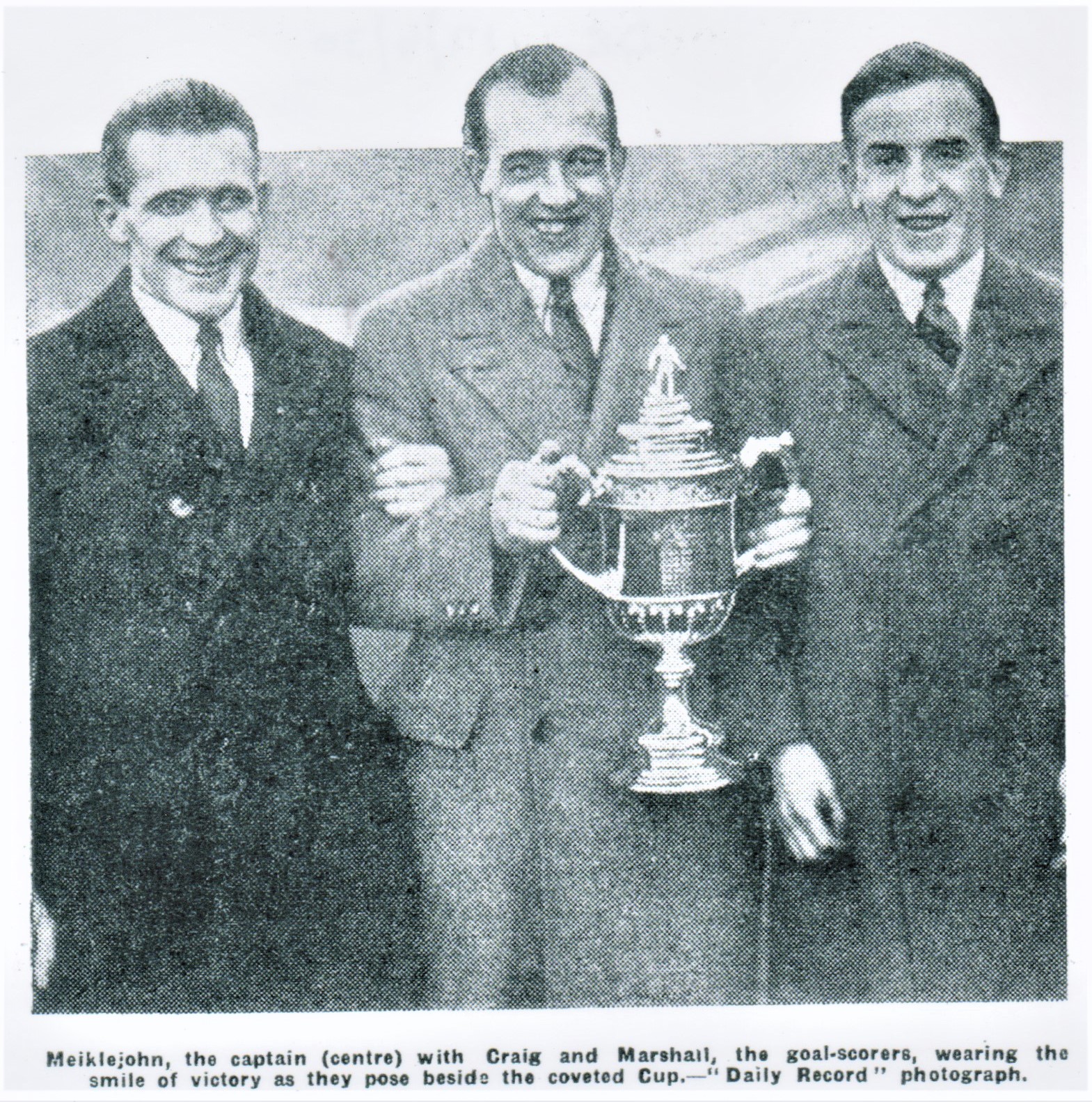
For the sixth time, Rangers were winners of the Scottish Cup, the most coveted prize in football. They beat worthy opponents in Partick Thistle, last night, at Hampden Park, where 104,000 people witnessed the replay after a goalless draw on Saturday, when the crowd numbered 108, Great is football! Rangers won despite the handicap of a muscle injury sustained by Alan Morton, who was lame for a three-quarters part of the match. Marshall scored for Rangers the only goal of the first half four minutes from the interval, while playing against a strong wind. Torbet equalised 26 minutes after the restart, and Craig registered the winning goal five minutes from time. You will remember, perhaps, what I told you about the effects of Wembley on the Rangers players as seen on Saturday. Well, here at Hampden last night, the effects had worn off. It was a different Rangers team altogether. Rangers, facing the stiff wind in the first half, were the only team who played the game as we expected both to play it, and more especially the Thistle, who as on Saturday, had the great good fortune to win the toss. But the Thistle sadly disappointed in the first half. Nobody seemed able to pull the team together. Passes were short or into the feet of an opponent. And Rangers were not slow to take full advantage of what was offered them. Though their goal was delayed until four-and-a-half minutes from the interval, they had long before that, proved themselves the superior side, both in team work, positional play, and individually. Even a mishap to Alab Morton, about 15 minutes after the start, which rendered him of little use afterwards, could not be turned to advantage by the Thistle. In centring from the touchline with his right foot, he jarred his thigh muscles. It is, as I know only too well, a most painful injury, and it gets worse the longer you remain on the field. Rangers more than merited their narrow half-time lead. From the way they had played, I looked for an even better second-half display, when they had the wind, but for some curious reason, the standard of play all round went back. Rangers came back somewhat to the Thistle’s level, although still having the best of it. Morton’s incapacity had begun to tell, and under the circumstances, I think the ball was played too much to him. When Torbet equalised 26 minutes after the second half had started, the Thistle had a great chance to pull themselves together. They missed the chance completely, faded back, and were deservedly beaten by Craig’s goal scored five minutes from the end. Many finals have been won by curious goals. This was another, I think the sun in Jackson’s eyes may have been troubling him, but in any case, Craig’s quickly-taken lob, beautifully times, did not seem so difficult to save as many of the shots the Thistle custodian had previously saved. But, on the game, as a whole, Rangers right well deserved to win the Cup for the sixth time. As for the Thistle, they must have some regrets, for they were not half the team they were in the first game. I could not fathom them at all. Still, they have done well to get to the final. I congratulate the winners and condole with the losers. I know what it is to be a Scottish Cup winning team, and in a defeated one, as well. All the players were agreed that the wind was worse than in the first game, and there is nothing worse than a wind when you are trying to play real football. Benting into it, the Rangers half-backs sent the ball well through to the forwards. Marshall and Archibald were strong on the run and from their driving movements the Thistle defence was hard put to it. Once Fleming went in with a lovely pass from Marshall, and there was instant danger for Thistle when Rae, anticipating Fleming’s run-in, got his foot to the ball just as the Ibrox centre shot. The longer the game went, the more surprising was the grip the Rangers took. Half-backs and forwards worked the ball skilfully and seemed able to judge the breeze to a fraction. But the Thistle half-backs could not get the weight of it at all, and the forwards quite failed to get together. It was no surprise when Rangers went ahead. McDonald, who had been playing with rare judgment, swung the ball across. Marshall fastened on, and without hesitation, shot hard. Lambie was in the way, and the ball rebounded to Marshall, who this time, shot hard into the into low down at Jackson’s left hand. There was a telling click in the shot, and Jackson, with a crowd of men in front of him, had no chance to make a desperate save. This happened, as I have told you, four-and-a-half minutes from the interval. It was good going for Rangers to score against such a breeze, and I looked for something special from them after the turn-round. Here we were disappointed. Morton of course, was practically a passenger, and Meiklejohn came by an injury which caused him to go behind the goal for repairs. But in the first few minutes of the second half, Fleming got away a great shot which Jackson saved grandly. Rangers were still playing the better game, although nothing like so good as in the first half. Jackson saved again brilliantly from Marshall, and then Archibald swept the ball just over the bar. But the danger was not all at the one end. From a miskick by Newry Hamilton, Grove got through, and just as he was boring in on goal, craig dashed round, and nipped the ball away from Grove’s toe. Then came the equaliser with 27 minutes of the second half gone. Ness got well away and centred right across to the other wing. Torbet met the ball first time, and his right foot shot, from close in, left Hamilton helpless. Right on the top of this the Rangers’ forwards went through and Jackson drew loud cheers for another grand save from McPhail. When McLeod sent Torbet away a fine chance was opened up for the Thistle. Torbet transferred to Ness, who had a clear run in, but Hamilton recovered quickly and disposed him. By this tome the play had fallen off, and there was some rash passing. There were visions of another draw, but it was not to be. Ledd than five minutes from the end Marshall was tearing through with a pass from Meiklejohn when his heels were clicked. Meiklejohn placed the free-kick into the goalmouth. Lambie headed out, and Craig catching the falling ball on the instep of the left foot, sent it, from about 25 yards out, high towards goal. It was a splendidly-judged effort by Craig, and I rather fancy the alertness and the accuracy with which he took his chance surprised Jackson. The sun too may have been in the Thistle goalkeeper’s eyes. He never got his hands to the ball, and – the Cup was won. In the last minute Morton hobbled in to accept a certain chance when the ball came over from the right, but his injury beat him. Both Hamilton and Jackson did their parts well, although I thought the Thistle man was not so cool and confident as he usually is, still, there is no doubt he saved Thistle from a heavier defeat. Hamilton had very little to do by comparison. Gray was a splendid ball all through. I liked particularly his heading in the first half, when he had to make some desperate interventions. Newry Hamilton was best in the second half. His recovery to beat Ness was one of the best things he did in the tie. Rae played another fine defensive game. He had something to grapple with in Marshall, and he stood to his guns with magnificent courage. Calderwood seemed upset a bit by Elliott’s uncertainty, and though he did well his game was not so finished as in Saturday’s match. At half-back Rangers were greatly superior, especially in the first half, when McDonald and craig played beautifully to their forwards, with nice variations in their passing. Meiklejohn was a grand tactician. I hope any young player present were taking not of his heading back which, I have often said, is one of the most valuable assets a man can have against a breeze. Forward heading against the breeze is always dangerous. Such great centre half-backs as James Cowan, Johnny Holt and Bobby Neil were adepts at the head-back. What went wrong with the Thistle half-backs? In the first half Elliott and McLeod made many mistakes, and even lambie seemed unable to make the ball answer. McLeod came better on to his game in the second half, but he could not get his forwards to galvanise themselves into life. Marshall was the most paying forward on the ground. He was a tremendous worker – going back, coming on, shoving the ball to the right and through the centre and – well, didn’t he begin the scoring? In the first half, Archibald forged ahead in dashing style, and got the ball across well. Fleming was getting a lot of balls too high, but he was always in the busy places. McPhail and Craig showed some of the prettiest combination in the match, and until he was injured, Morton joined in to make a triangle of it. Thistle’s forwards disappointed me. They can play very much better – I have seen them do it. They did it on Saturday. Ballantyne tried hard, but he could not get the machinery to work. Torbet, I thought the best of the line, but even he was not the thrustive raider I have seen him. Ness seemed to lack confidence in himself, and Grove’s passed too often lacked precision. The sense of touch was lost. Boardman, between two wings playing below their best, could not get scope to fit in.