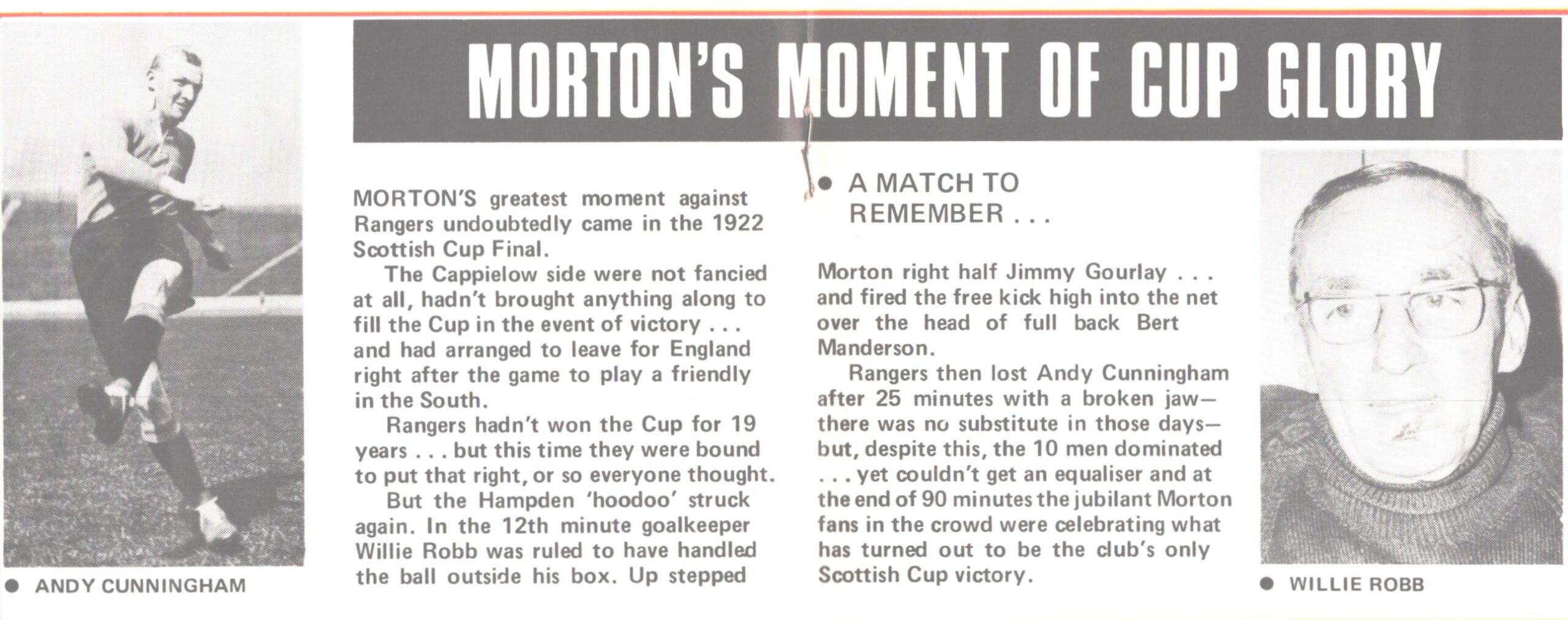
Gourlay 12
A Cunningham went off (fractured jaw) 26 - played with 10 men
Match Information
Attendance: 70,000
Referee: Tom Dougray (Bellshill)
Matchday: Saturday
Match Trivia
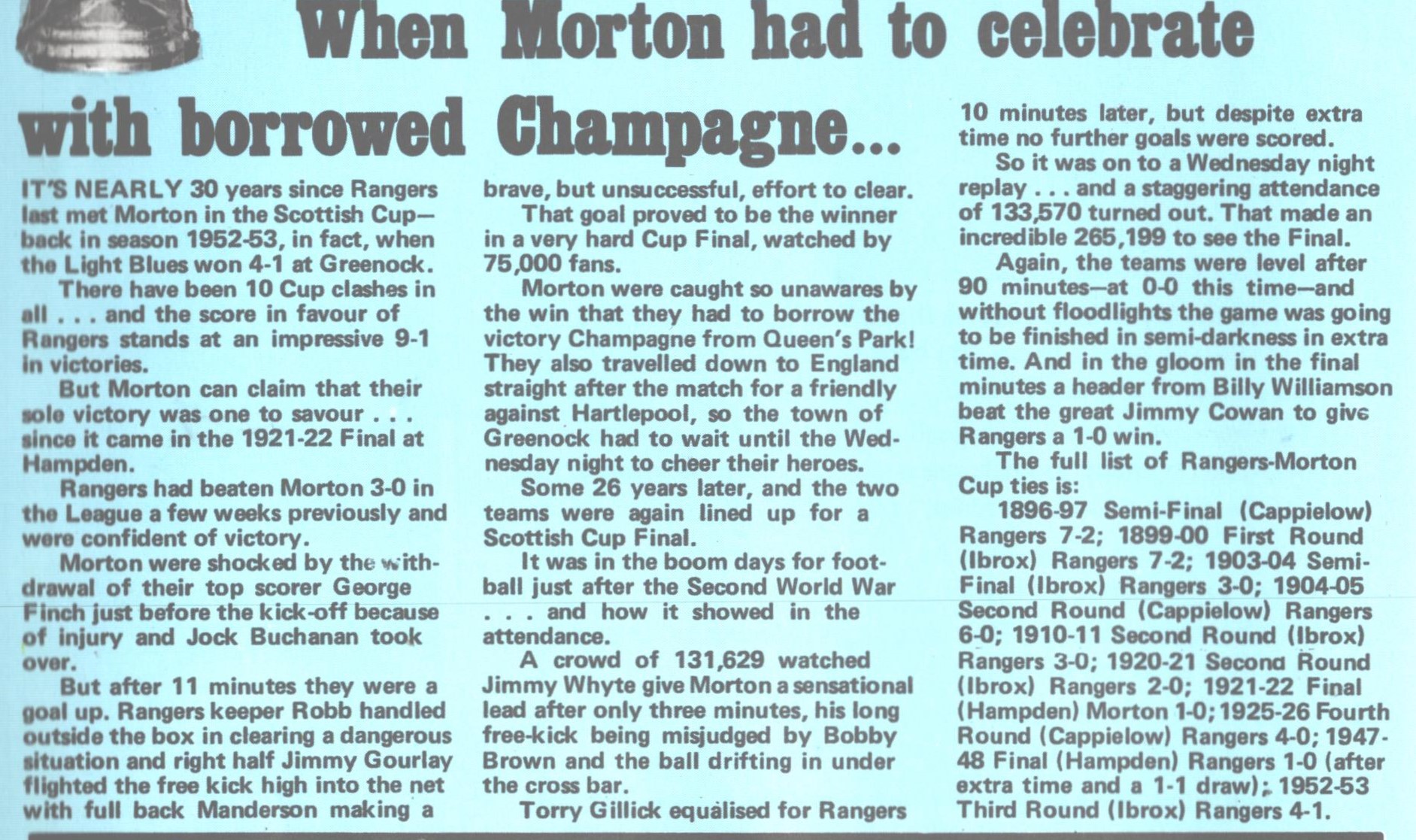
For the first time in a long career of cloud and sunshine, with the drab periods more in evidence than the bright patches, the Morton Club from Greenock triumphed over the Rangers at Hampden Park yesterday by a goal scored from a free kick splendidly judged by Gourlay when the contest had gone eleven minutes. There was no other score, although the beaten side had two chances for one that fell the way of the victors. The loss of the Cup was a misfortune to the Ibrox Club, but a greater disaster befell them in the loss of their captain, Andrew Cunningham, who sustained a fracture to the lower right jawbone early in the game. He played pluckily on for fifteen minutes after rising from the ground, holding both hands to the face. The painful injury compelled Cunningham to leave the field. The knowledge that their splendid leader had been taken to the hospital did not brighten the hopes of the Ibrox players when they trooped into the pavilion at the interval. They had played against the wind with the prospect of better fortune later on, but the hope they would break the spell of bad luck that has shadowed the club since that memorable triumph over the Heart of Midlothian in 1902-3, when three games were played, never materialised. They played in the last half hour like a team haunted by the dread of defeat. They made tremendous rallies to pull the game out if the fire, but fate, in the person of John McIntyre, the right back, and Edwards, the Morton goalkeeper, conspired to defeat their most valiant efforts. One terrific scrimmage in the Morton goalmouth, fifteen minutes from time, was probably the wildest scramble to force a goal that was ever witnessed in an Association match. The two most notable incidents in this impact of men was when McIntyre, behind the ruck of struggling humanity, with Edwards drawn out of his goal, headed out a ball under the bar which would have counted ninety-nine times out of a hundred. The other one was the appearance of the goalkeeper fighting his way clear of the mass of desperate opponents and emerging from the scrum holding in a vice clutch the ball he had guarded so well. He walked to Referee Dougray and appealed for a ‘foul’. The sensational incident terminated with a free kick against the Rangers. Immediately before and after this happened the rangers had probably their best chances to equalise. Alan Morton, in the first instance, rounded Gourlay and McIntyre in succession, and seemed certain to achieve his purpose. Edwards ran out and diverted the ball in weird fashion for corner kick. There was a shade of luck then for the fearless goalie. The second opening was created by the combined efforts of Henderson, Cairns and Morton, who in their desperation seemed to carry all before them. This time the raven-looked McIntyre saved an ugly situation for Morton by the courage of one whose confidence inspired the whole defence. The closing rally of the Light Blues that lingers in the memory was another pell-mell rush, which ended in Dixon unceremoniously bundling Edwards into the net. Once again, a free kick repelled the invaders. A corner kick a few minutes from time, taken by Archibald, found many eager heads raised for the centred ball. An excited rush, the right-about once more, and – despair for Ibrox. In a season notorious for sensational football upheavals, the climax surely was reached in this unexpected victory of the Greenock players. Everything seemed to presage a win for the Rangers, who were the hottish of favourites, out of Greenock, where hope was more dominant than the confidence of victory. Once again, the glorious uncertainty of the game was illustrated in the result. The greater experience of big games was on the side of the conquered team, which contained within its rank six players who had represented Scotland in National matches this season. In 44 League games between the clubs the Rangers won 31 against 9 for Morton, and in past Cup games between the clubs the Rangers had never lost a goal and won every time. Last season Morton fell to the mighty men of Ibrox by two goals to nothing at Ibrox Park in the second round. Yesterday ten of the winning players that day opposed the new Cup holders, the exception being Muirhead for Bowie, at half-back back. Morton had fresh backs yesterday. Robert Brown was at left half at Hampden, and alongside McIntyre, who was originally also a half-back, the Kilwinning defender, played the game of his life. Another change was the appearance of Gourlay at right half, when the emergency of the club found him equally adaptable. As a forward, this veteran Greenock player has been in the van for many years. Surely the Rangers were entitled to be established favourites by the public. They won both their League engagements over Morton this season – the last one by three clear goals. The ill-luck that has been their in Cup finals at Hampden Park (the present ground) as well as in other struggles for the elusive trophy, shadowed them in this latest quest for the emblem of Scottish supremacy. Last year’s victory of Partick Thistle pales before this achievement of Morton’s at the expense of the most popular team in football. I have outlined the Ibrox picture. The joy side is Morton. What a wonderful feat it was for them to rise superior to the absence of George French, the one member of the team upon whom most depended. French is probably the best centre forward after Andy Wilson. He was injured against the Hearts the previous Saturday. Into the breach stepped Buchanan – a lanky youth who joined Morton as a half-back last year from St Mirren. The Paisley youth was a big success in this momentous test for him. He was full of confidence, dribbled well, risked much, and was able to balance his inside forwards in a game almost devoid of artistry. Twice Buchanan just failed to add to Morton’s advantage. Over this scramble of a game, the man from Paisley never lost his head. McNab contributed finely to the enthusiasm of the Morton players. The right winger was in the beat of form, and he, like the rest of the attack, were seen at their best when playing against the gusty gale in the second half. Two of the youngest players on the field – McKay and A Brown – the inside forwards on the winning side, are deserving of the highest praise for the coolness and skill they displayed in a contest where men were laid low with an abandon and recklessness, I have never seen equalled in a Cup-tie. The ‘towsyness’ of the struggle recalled memories of Dumbarton in the days of Leitch Kerr, of Cambuslang, in the epoch of the Gourley’s, and of the Hibernians of the ‘eighties’ in Cup games, where rivalry impelled men of condescend to bring down opponents regardless of consequences. The spirit of fair play did not enter much into this latest struggle for a Cup. Both sides sinned, and the offences were of the most glaring description. Had it been a provincial final between mining teams, and the like breaches of the cannons of sport had taken place, more than one culprit would have been sent to the pavilion. As an exhibition, the game is best forgotten. It rivalled, for rough play, the notorious English Cup final when Aston Villa triumphed over Sunderland at the Crystal Palace, and Harry Hampton and Charles Thomson had to suffer a month’s suspension for their share in it. The referee on that occasion was also pilloried. The offenders need not be singled out in yesterday’s final. The victims were numerous and were not confined to the winning side. Morton’s victory was a triumph for youth. The great men of the side were Edwards, McIntyre and Robert Brown. Their defence – spoilation and aggressiveness – was comparable with the brilliance of Kenneth Campbell, John Marshall and James Blair for Scotland against England at Birmingham. The effect was much the same in deciding the issue. There was never the same ‘feckless’ play on the Morton side that was so often revealed in the play of the disheartened and vanquished Rangers. The loss of their captain meant for them at least the chance of a replay. The goalkeeper (Robb) cannot be blamed for the disaster. The crux of the failure of the team to combine rested chiefly with the half-backs. The forwards could not settle so impetuous was the clash of the other side to get as quickly as they could to the ball. Alan Morton was the Rangers’ chief hope, and late in the game he, more than anyone, singlehanded, almost achieved what looked impossible against a defence that did not stand on ceremony. The Morton half-backs, as a trio, were better than the Rangers. In the sense that a new district is tapped by the victory of Morton, the spreading of the Cup honours is of real value to the game. The tun of the play needs no extended review. It was too much of a scramble to be of interest to the reader.