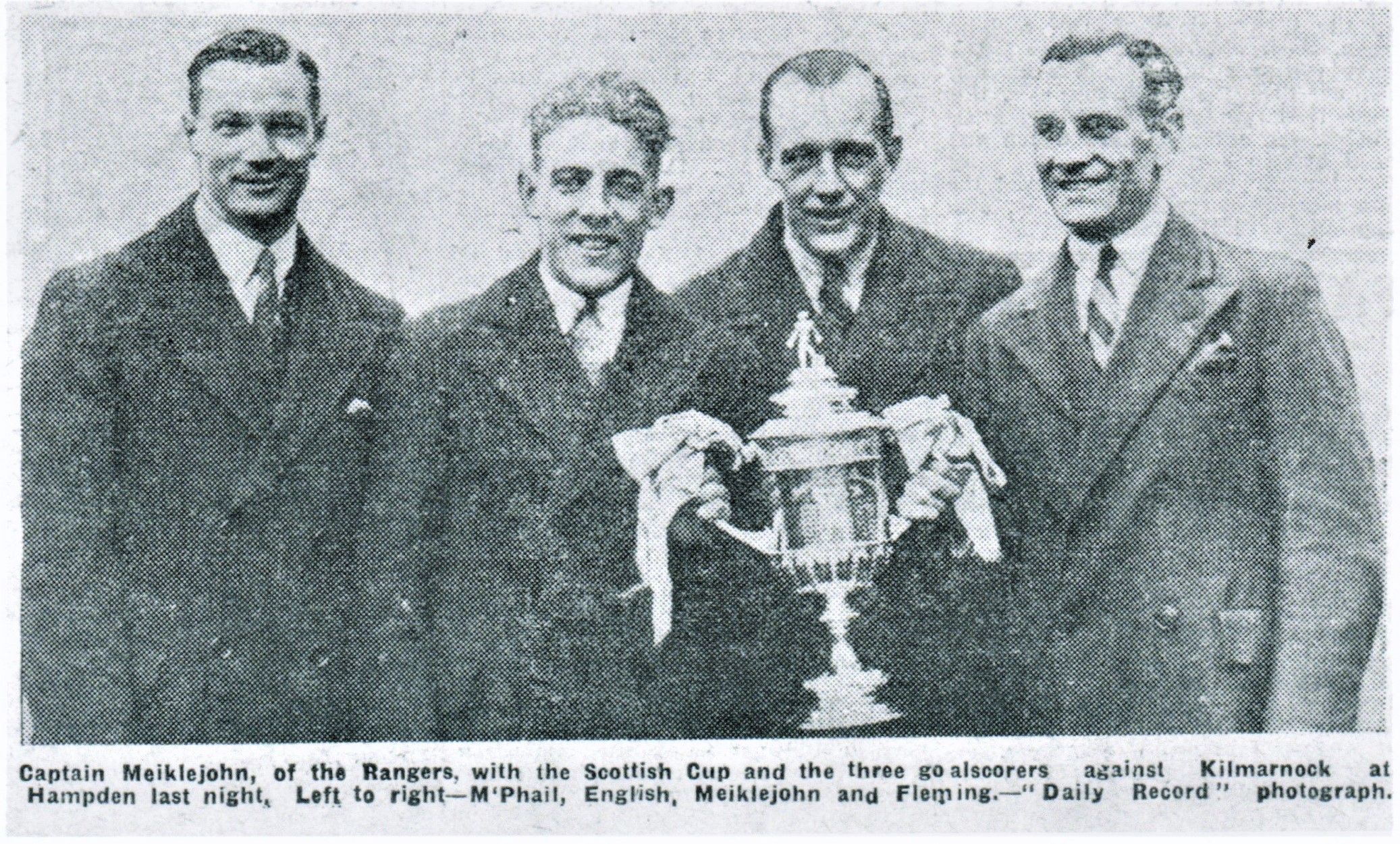
Fleming 10
B McPhail 69
English 71
Match Information
Attendance: 105695
Referee: P Craigmyle (Aberdeen)
Match Trivia
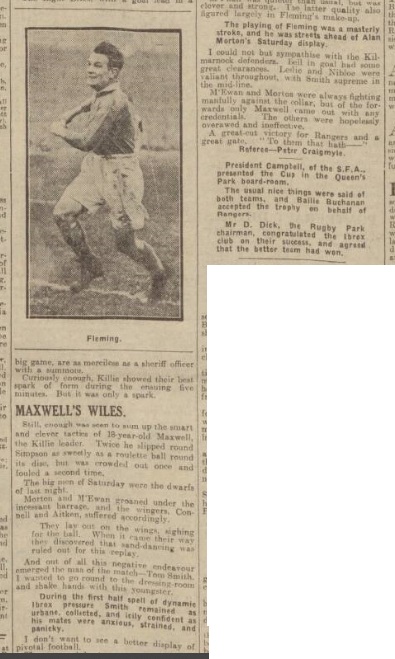
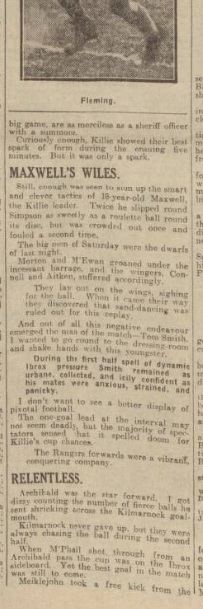
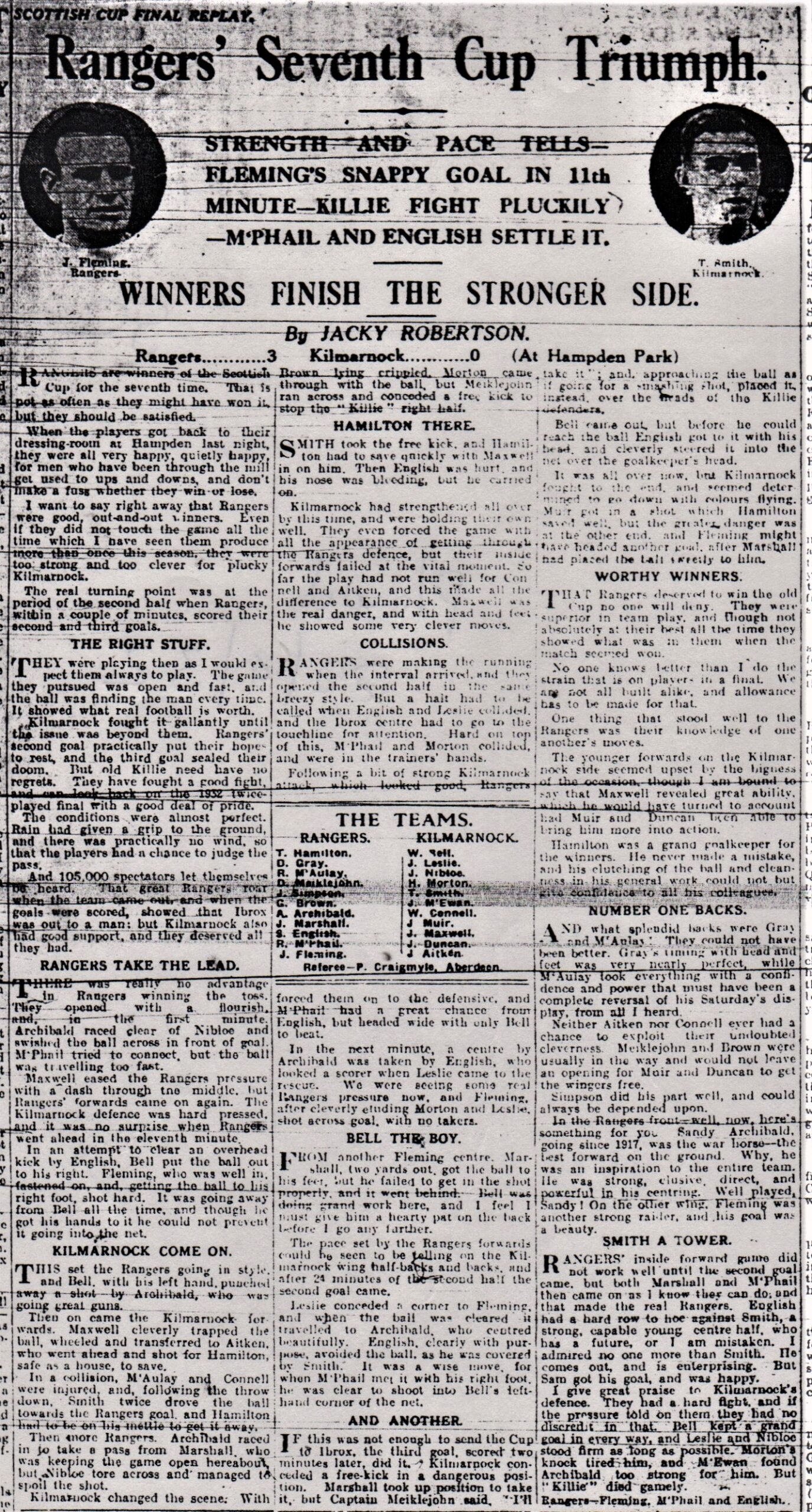
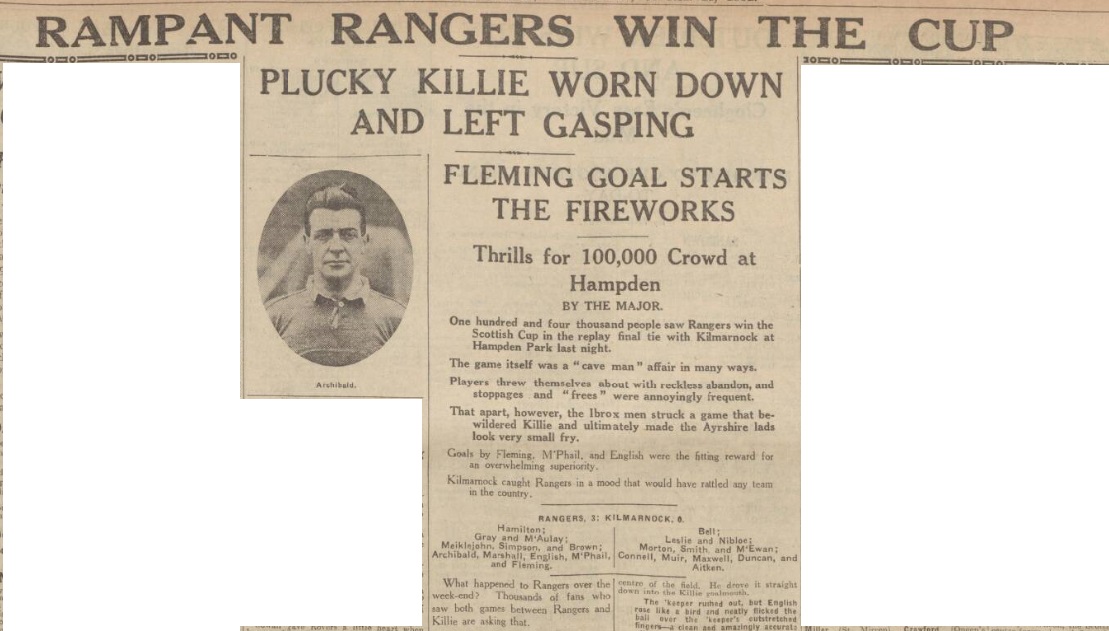
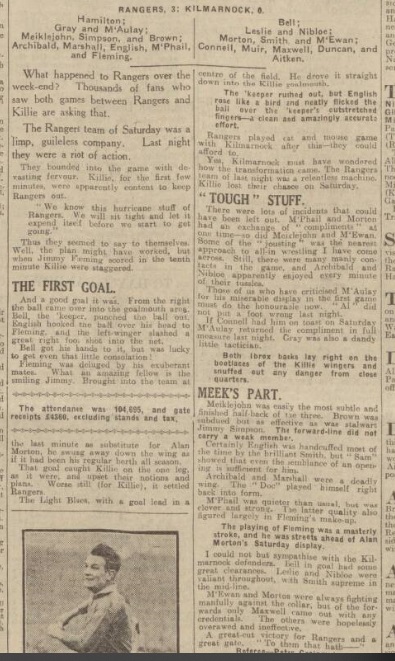
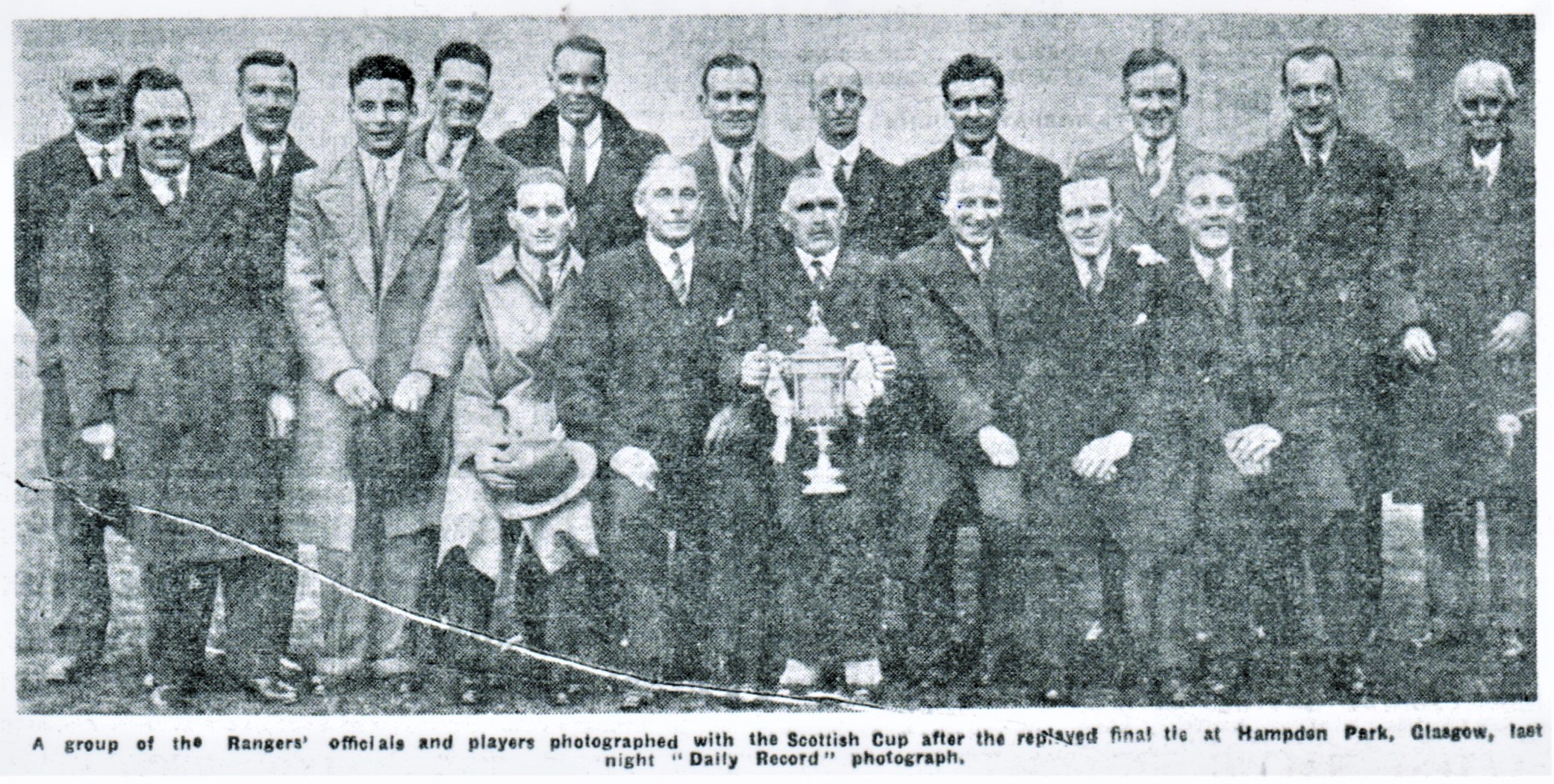
Rangers are winners of the Scottish Cup for the seventh time. That is not as often as they might have won it, but they should be satisfied. When the players got back to their dressing-room at Hampden last night, they were all very happy, quietly happy, for men who have been through the mill get used to ups and downs, and dont make a fuss whether they win or lose. I want to say right away that Rangers were good, out-and-out-winners. Even if they did not touch the game all the time which I have seem them produce more than once this season, they were too strong and too clever for plucky Kilmarnock. The real turning point was at the period of the second half when Rangers, within a couple of minutes, scored their second and third goals. They were playing then as I would expect them always to play. The game they pursued was open and fast, and the ball was finding the man every time. It showed what real football is worth. Kilmarnock fought it gallantly until the issue was beyond them. Rangers second goal practically put their hopes to rest, and the third goal sealed their doom. But old Killie need have no regrets. They have fought a good fight and can look back on the 1932 twice-played final with a good deal of pride. The conditions were almost prefect. Rain had given a grip to the ground, and there was practically no wind, so that the players had a chance to judge the pass. And 105,000 spectators let themselves be heard. That great Rangers roar when the teams came out and when the goals were scored, showed that Ibrox was out to a man; but Kilmarnock also had good support, and they deserved all they had. There was really no advantage in Rangers winning the toss. They opened with a flourish, and in the first minute, Archibald raced clear of Nibloe and swished the ball across in front of goal. McPhail tried to connect, but the ball was travelling too fast. Maxwell eased the Rangers pressure with a dash through the middle, but Rangers forwards came on again. The Kilmarnock defence was hard pressed, and it was no surprise when Rangers went ahead in the eleventh minute. In an attempt to clear an overhead kick by English, Bell put the ball out to his right. Fleming who was well in, fastened on, and getting the ball to his right foot, shot hard. It was going away from Bell all the time, and though he got his hands to it he could not prevent it going into the net. This set the Rangers going in style, and Bell, with his left hand, punched away a shot by Archibald, who was going great guns. Then on came the Kilmarnock forwards. Maxwell cleverly trapped the ball, wheeled and transferred to Aitken, who went ahead and shot for Hamilton, safe as a house, to save. In a collision, McAulay and Connell were injured, and following the throw down, Smith twice drove the ball towards the Rangers goal and Hamilton had to be on his mettle to get it away. Then more Rangers. Archibald raced in to take a pass from Marshall who was keeping the game open hereabout, but Nibloe tore across and managed to spoil the shot. Kilmarnock changed the scene. With Brown lying crippled, Morton came through with the ball, but Meiklejohn ran across and conceded a free kick to stop the Killie right half. Smith took the free kick, and Hamilton had to save quickly with Maxwell in on him. Then English was hurt, and his nose was bleeding, but he carried on. Kilmarnock had strengthened all over by this time and were holding their own well. They even forced the game with all the appearance of getting through the Rangers defence, but their inside forwards failed at the vital moment. So far, the play had not run well for Connell and Aitken, and this made all the difference to Kilmarnock. Maxwell was the real danger, and with head and feet he showed some very clever moves. Rangers were making the running when the interval arrived, and they opened the second half in the same breezy style. But a halt had to be called when English and Leslie collided, and the Ibrox centre had to go to the touchline for attention. Hard on top of this, McPhail and Morton collided, and were in the trainers hands. Following a bit of strong Kilmarnock attack, which looked good, Rangers forced them on to the defensive, and McPhail had a great chance from English, but headed wide with only Bell to beat. In the next minute, a centre by Archibald was taken by English, who looked a scorer when Leslie came to the rescue. We were seeing some real Rangers pressure now and Fleming, after cleverly eluding Morton and Leslie, shot across goal, with no takers. From another Fleming centre, Marshall, two yards out, got the ball to his feet, but he failed to get in the shot properly, and it went behind. Bell was doing grand work here, and I feel I must give him a hearty pat on the back before I go any farther. The pace set by the Rangers forwards could be seen to be telling on the Kilmarnock wing half-backs and backs, and after 24 minutes of the second half the second goal came. Leslie conceded a corner to Fleming, and when the ball was cleared it travelled to Archibald, who centred beautifully. English clearly with purpose, avoided the ball, as he was covered by Smith. It was a wise move for when McPhail met it with his right foot, he was clear to shoot into Bells left-hand corner of the net. If this was not enough to send the Cup to Ibrox, the third goal, scored two minutes later did it. Kilmarnock conceded a free-kick in a dangerous position. Marshall took up position to take it, but Captain Meiklejohn said, Ill take it, and approaching the ball as if going for a smashing shot, placed it, instead, over the heads of the Killie defenders. Bell came out, but before he could reach the ball English got to it with his head, and cleverly steered it into the net over the goalkeepers head. It was all over now, but Kilmarnock fought to the end, and seemed determined to go down with colours flying. Muir got in a shot which Hamilton saved well, but the greater danger was at the other end, and Fleming might have headed another goal after Marshall had placed the ball sweetly to him. That Rangers deserved to win the old Cup no one will deny. They were superior in team play, and though not absolutely at their best all the time they showed what was in them when the match seemed won. No one knows better than I do the strain that is on players in a final. We are not all built alike, and allowance had to be made for that. One thing that stood well to the Rangers was their knowledge of one anothers moves. The younger forwards on the Kilmarnock side seemed upset by the bigness of the occasion though I am bound to say that Maxwell revealed great ability, which he would have turned to account had Muir and Duncan been able to bring him more into action. Hamilton was a grand goalkeeper for the winners. He never made a mistake, and his clutching of the ball and cleanness in his general work could not but give confidence to all his colleagues. And what splendid backs were Gray and McAulay. They could not have been better. Grays timing with head and feet was very nearly perfect, while McAulay took everything with a confidence and power that must have been a complete reversal of his Saturdays display, from all I heard. Neither Aitken nor Connell ever had a chance to exploit their undoubted cleverness. Meiklejohn and Brown were usually in the way and would not leave an opening for Muir and Duncan to get the wingers free. Simpson did his part well and could always be depended upon. In the Rangers front well, now, heres something for you. Sandy Archibald, going since 1917, was the war horse the best forward on the ground. Why, he was an inspiration to the entire team. He was strong, elusive, direct and powerful in his centring. Well played, Sandy! On the other wing, Fleming was another strong raider, and his goal was a beauty. Rangers inside forwards game did not work well until the second goal came, but both Marshall and McPhail then came on as I know they can do, and that made the real Rangers. English had a hard row to hoe against Smith, a strong, capable young Centre half, who had a future, or I am mistaken. I admired no one more than Smith. He comes out and is enterprising. But Sam got his goal and was happy. I gave great praise to Kilmarnocks defence. They had a hard fight, and if the pressure told on them, they had no discredit in that. Bell kept a grand foal in every way, and Leslie and Nibloe stood firm as long as possible. Mortons knock tired him, and McEwan found Archibald too strong for him. But Killie died gamely.