Maxwell 41
B McPhail 51
Match Information
Attendance: 111,982
Referee: P Craigmyle (Aberdeen)
Match Trivia
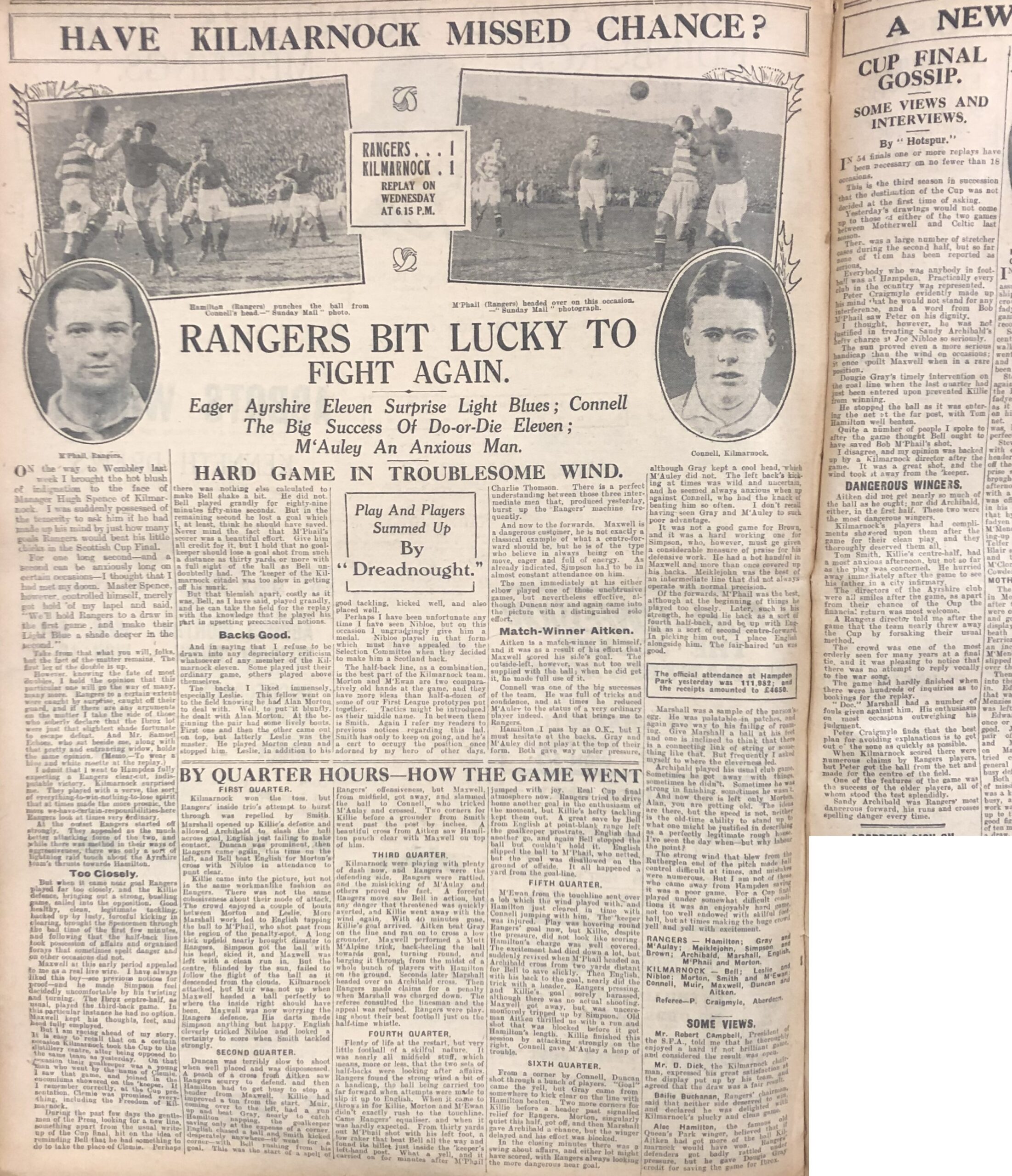
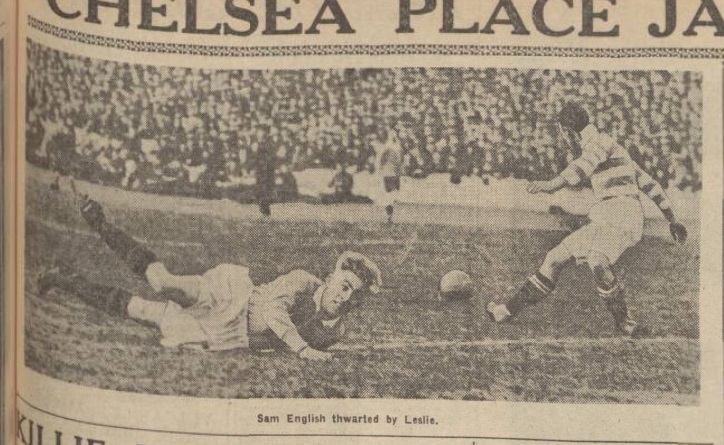
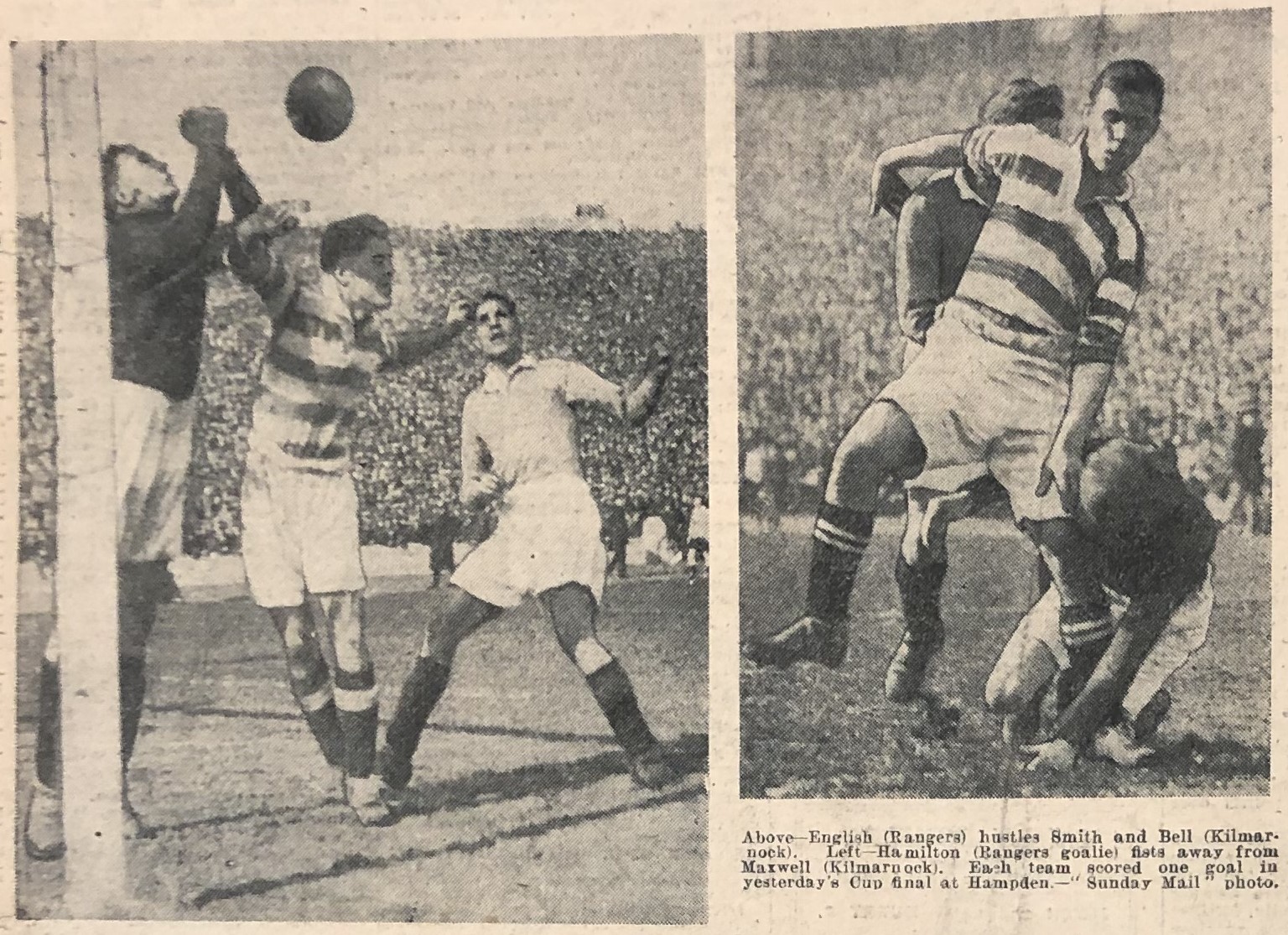
On the way to Wembley last week, I brought the hot blush of indignation to the face of Manager Hugh Spence of Kilmarnock, I was suddenly possessed of the temerity to ask him if he had made up his mind by just how many goals Rangers would beat his little chicks in the Scottish Cup Final. For one long second and a second can be anxiously long on certain occasions I thought that I had met my doom. Master Spence, however, controlled himself, merely got hold of my lapel and said, Well Hold Rangers to a draw in the first came, and made their Light Blue a shade deeper in the second. Take from what you will, folks but the fact of the matter remains. The first leg of the double is up. However, knowing the fate of most doubles, I hold the opinion that this particular one will go the way of many, many more. Rangers to a certain extent were caught by surprise, caught off their guard, and if there are any arguments on the matter, I take the side of those who soberly declare that the Ibrox lot were just that slightest shade fortunate to escape defeat. And Mr Samuel Echoes, who sat beside me, along with that pretty and entrancing widow, holds the same opinion. (Memo To wear a blue and white rosette at the replay.) I admit that I went to Hampden fully expecting a Rangers clean-cut, indisputable victory. Kilmarnock surprised me. They played with a verve the sort of everything-to-win-nothing-to-lose spirit that at times made the more prosaic, the more we-have-certain-responsibilities-here Rangers look at times very ordinary. At the outset Rangers started off strongly. They appealed as the much better attacking force of the two, and while there was method in their ways of aggressiveness, there was only a sort of lightning raid touch about the Ayrshire teams thrusts towards Hamilton. But when it came near goal Rangers played far too closely, and the Killie defence bringing out a strong, bustling game sailed into the opposition. Good healthy, clean, legitimate tackling, backed up by lusty, forceful kicking on clearing, brought the Spencemen through the bad time of the first few minutes, and following that the half-back line took possession of affairs and organised forays that sometimes-spelt danger and on other occasions did not. Maxwell at this early period appealed to me as a real live wire. I have always liked this boy see previous notices for proof and he made Simpson feel decidedly uncomfortable by his twisting and turning. The Ibrox centre-half, as usual, played the third-back game. In this particular instance he had no option. Maxwell kept his thoughts, feet and head fully employed. But I am racing ahead of my story. It is easy to recall that on a certain occasion Kilmarnock took the cup to the distillery centre, after being opposed to the same team as yesterday. On that occasion their goalkeeper was a young man who went by the name of Clemie. I saw that game and joined in the encomiums showered on the keeper. If I remember correctly, at the Cup presentation, Clemie was promised everything, including the Freedom of Kilmarnock. During the past few days, the gentlemen of the Press, looking for a new line, something apart from the usual write-up of the Cup final, hit on the idea of reminding Bell that he had something to do to take the place of Clemie. Perhaps there was nothing else calculated to make Bell shake a bit. He did not. Bell played grandly for eighty-nine minutes fifty-nine seconds. But in the remaining second, he lost a goal which I, at least, think he should have saved. Never mind the fact that McPhails scorer was a beautiful effort. Give him all credit for it, but I hold that no goalkeeper should lose a goal shot from such a distance as thirty yards or more with a full sight of the ball as Bell undoubtedly had. The keeper of the Kilmarnock citadel was too slow in getting off his mark. But that blemish apart, costly as it was, Bell, as I have said, played grandly, and he cane take the field for the replay with the knowledge that he played his part in upsetting preconceived notions. And in saying that I refuse to be drawn into any depreciatory criticism, whatsoever of any member of the Kilmarnock eleven. Some played just their ordinary game, others played above themselves. I backs I liked immensely, especially Leslie. This fellow went on to the field knowing he had Alan Morton to deal with. Well, to put it bluntly, he dealt with Alan Morton. At the beginning the pair had some lively bouts. First one and then the other came out on top, but latterly Leslie was the master. He played Morton clean and stopped him. Leslie, in addition to his good tackling, kicked well, and also placed well. Perhaps I have been unfortunate any time I have seen Nibloe, but on this occasion I ungrudgingly give him a medal. Nibloe played in that form which must have appealed to the Selection Committee when they decided to make him a Scotland back. The half-back line, as a combination, is the best part of the Kilmarnock team. Morton and McEwan are two comparatively old hands at the game, and they have more ideas than half-a-dozen of some of our First League prototypes put together. Tactics might be introduced as their middle name. In between them is Smith. Again, I refer my readers to previous notices regarding this lad. Smith has only to keep on going, and hes a cert to occupy the position once adorned by my hero of other days, Charlie Thomson. There is a perfect understanding between those three intermediate men, that produced yesterday, burst up the Rangers machine frequently. And now the forwards. Maxwell a dangerous customer, he is not exactly a classical example of what a centre-forward should be, but he is of the type who believe in always being on the move, eager and full of energy. As already indicated, Simpson had to be in almost constant attendance on him. The men immediately at his either elbow played one of those unobtrusive games, but nevertheless effective, although Duncan now and again came into the picture with a distinguished solo effort. Aitken is a match-winner in himself, and it was as a result of hid effort that Maxwell scored his sides goal. The outside-left, however, was not took well supplied with the ball; when he did get it, he made full use of it. Connell was one of the big successes if the team. He was full of tricks and confidence, and at times he reduced McAulay to the status of a very ordinary player indeed. And that brings me to Rangers. Hamilton, I pass by as OK, but I must hesitate at the backs. Gray and McAulay did not play at the top of their form. Both gave way under pressure, although Gray kept a cool head, which McAulay did not. The left backs kicking at timed was wild and uncertain, and he seemed always anxious when up against Connell, who had the knack of beating him so often. I dont recall having seen Gray and McAulay so such poor advantage. It was not a good game for Brown, and it was a hard working one for Simpson, who, however, must be given a considerable measure of praise for his defensive work. He had a hot handful in Maxwell and more than once covered up his backs. Meiklejohn was the best of an intermediate line that did not always operate with normal precision. Of the forwards, McPhail was the best, although at the beginning of things he played too closely. Later, such is his strength, he could lie back as a sort of fourth half-back and be up with English as a sort of second centre-forward. In picking him out, I place English alongside him. The fair-haired un was good. Marshall was a sample of the parsons egg. He was palatable in patches, and again gave way to his failing of roaming. Give Marshall a ball at his feet and one is inclined to think that there is a connecting link of string or something like that. But frequently I asked myself to where the cleverness led. Archibald played his usual club game. Sometimes he got away with things, sometimes he didnt. Sometimes he was strong in finishing, sometimes he wasnt. And there is left only Morton. Alan, you are getting old. The ideas are there, but the speed is not, neither is the old-time ability to stand up to what one might be justified in describing as a perfectly legitimate rough house. Ive seen the day when but why labour the point? The strong wind that blew from the Rutherglen end of the pitch made ball control difficult at timed, and mistakes were numerous. But I am not of those who came away from Hampden saving it was a poor game. For a Cup final played under somewhat difficult conditions it was an enjoyable hard game, nit too well endowed with skilful football, but at timed making the huge crowd yell and yell with excitement. Kilmarnock won the toss, but Rangers inside trios attempt to burst through was repelled by Smith. Marshall opened up Killies defence and allowed Archibald to slash the ball across goal, English just failing to make contact. Duncan was prominent, then Rangers came again, this time on the left, and Bell beat English for Mortons cross with Nibloe in attendance to punt clear. Killie came into the picture, but not in the same workmanlike fashion as Rangers. There was not the same cohesiveness about their mode of attack. The crowd enjoyed a couple of bouts between Morton and Leslie. More Marshall work led to English tapping the ball to McPhail, who shot past from the region of the penalty-spot. A long kick upfield nearly brought disaster to Rangers. Simpson got the ball with his head, skied it, and Maxwell was left with a clean run in. But the centre, blinded by the sun, failed to follow the flight of the ball as it descended from the clouds. Kilmarnock attacked, but Muir was not up when Maxwell headed a ball perfectly to where the inside right should have been. Maxwell was now worrying the Rangers defence. His darts made Simpson anything but happy. English cleverly tricked Nibloe and looked a certainty to score when Smith tackled strongly. Duncan was terribly slow to shoot when well placed and was dispossessed. A peach of a cross from Aitken saw Rangers scurry to defend, and then Hamilton had to get busy to stop a header from Maxwell. Killie had improved a ton from the start, Muir, coming over to the left, had a run up and beat Gray, nearly to catch Hamilton napping, the goalkeeper saving only at the expense of a corner. English chased a ball and Smith kicked desperately anywhere it went for a corner with Bell rushing from his goal. This was the start of a spell of Rangers offensiveness, but Maxwell, from midfield, got away, and slammed the ball to Connell, who tricked McAulay and crossed. Tow corners for Killie before a grounder from Smith went past the post by inches. A beautiful cross from Aitken saw Hamilton punch clear with Maxwell on top of him. Kilmarnock were playing with plenty of dash now, and Rangers were the defending side. Rangers were rattled, and the miskicking of McAulay and others proved the fact. A forceful Rangers move saw Bell in action, but any danger that threatened was quickly averted, and Killie went away with the wind again. With 40 minutes gone, Killies goal arrived. Aitken beat Gray on the line and ran on to cross a low grounder. Maxwell performed a Mutt McAlpine trick, back-heeling the ball towards goal, turning round, and barging it through from the midst of a whole bunch of players with Hamilton on the ground. Seconds later Marshall headed over an Archibald dross. Then Rangers made claims for a penalty when Marshall was charged down. The referee consulted the linesman, and the appeal was refused. Rangers were playing about their best football just on the half-time whistle. Plenty of life at the restart, but very little football of a skilful nature. It was nearly all midfield stuff, which means, more or less, that the two sets of half-backs were looking after affairs. Rangers found the strong wind a bit of a handicap, the ball being carried too far forward when attempts were made to slip it up to English. When it came to throws in for Killie, Morton and McEwan didnt exactly rush to the touchline. Came Rangers equaliser, and when it was hardly expected. From thirty yards out McPhail shot with his left foot, a low raker that beat Bell all the ay and found its billet just inside the keepers left-hand post. What a yell, and it carried on for minutes after McPhail jumped with joy. Real Cup final atmosphere now. Rangers tried to drive home another goal in the enthusiasm of the moment, but Killies hefty tackling kept them out. A great save by Bell from English at point-black range left the goalkeeper prostrate. English had another go, and again Bell stopped the ball bur couldnt hold it. English slipped the ball to McPhail, who netted, but the goal was disallowed on the ground of offside. It all happened a yard from the goal-line. McEwan from the touchline sent over a lob which the wind played with, and Hamilton just cleared in time with Connell jumping with him. The keeper was injured. Play was hovering round Rangers goal now, but Killie, despite the pressure, did not look like scoring. Hamiltons charge was well covered. The excitement had died down a lot, but suddenly revived when McPhail headed an Archibald cross from two yards distant for Bell to save slickly. Then English, with his back to the goal, nearly did the trick with a header. Rangers pressing, and Killies goal sorely harassed, although there was no actual shooting. Maxwell got away but was unceremoniously tripped up by Simpson. Old man Aitken thrilled us with a run and shot that was blocked before it got Hamiltons length. Killie finished this session by attacking strongly on the right. Connell gave McAulay a heap of trouble. From a corner by Connell. Duncan shot through a bunch of players. Goal came the yell, but Gray came from somewhere to kick clear on the line with Hamilton beaten. Two more corners for Killie before a header past signalled relief for Rangers. Morton, singularly quiet this half, got off, and then Marshall gave Archibald a chance, but the winger delayed, and his effort was blocked. In the closing minutes there was a swing about affairs, and either lot might have scored, with Rangers always looking the more dangerous near goal.