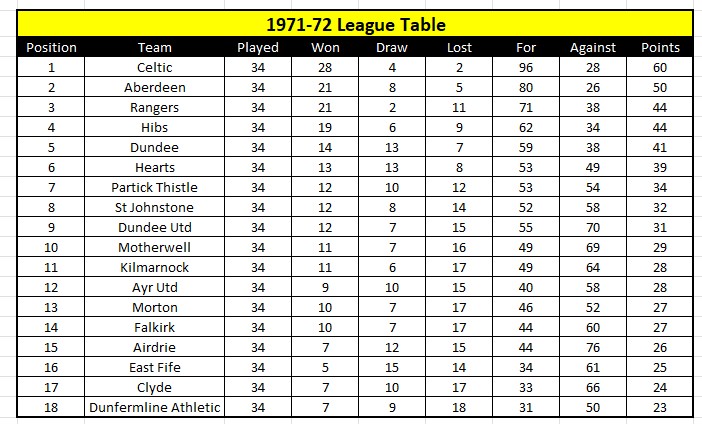
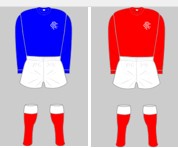
Written by Alistair Aird The League Cup win and the return of the totemic Willie Waddell had seemingly galvanised Rangers. It was hoped that both would be the foundation upon what a serious challenge to Celtic for the league title would be built. Jock Stein’s side were aiming for a seventh successive Division One title, and the Rangers supporters were hoping see their heroes sustain a title race for the first time since Colin Stein’s six-week suspension cost them dearly in season 1968/69. But Waddell’s side couldn’t have got off to a worse start in the title race. They lost four of their first five league games, and by the end of September, they had lost three times against Celtic, once in the league and twice in the sectional stages of the League Cup. Lou Macari opened the scoring for Celtic, but a penalty from Willie Johnston and a goal from Colin Stein earned Rangers a slender half time advantage. Kenny Dalglish equalised after 66 minutes, but four minutes later, Rangers were reduced to 10 men when Alfie Conn was dismissed by referee J. W Paterson from Bothwell. Booked in the first half, Conn was dismissed for a foul on Tommy Callaghan. But the numerical disadvantage didn’t seem to perturb Rangers. Stein looked to have scored his second goal of the game two minutes after Conn departed, but his score was ruled out for a foul on the Celtic goalkeeper, Evan Williams. And there would be a sucker punch winner for Celtic in the last minute of the game when Jimmy Johnstone netted the winning goal. But Rangers got their house in order after that. A 3-2 defeat at home against Dundee on 13 November was the only blemish in the 13 league matches that followed that last-gasp Old Firm defeat. Twelve wins – including a Christmas Day victory at Easter Road - meant that Rangers went into the second Old Firm league match on 3 January seven points adrift of their rivals who had dropped points in just two of their 18 league fixtures. A win at Parkhead therefore fell into the ‘essential’ category. The diminutive Jimmy Johnstone headed Celtic in front 10 minutes before the interval, and with seven minutes remaining, Stein netted the equalising goal. But in stoppage time, the Celtic left back, Jim Brogan, in an advanced position, capatilised on slack defending to head in the winning goal. By the end of the campaign, six of the 17 league games played at Ibrox had been lost. Dunfermline Athletic, who finished bottom of the table, were one of the teams to inflict a home defeat on Rangers. Celtic, Aberdeen, Dundee, Morton and Hibernian were the others. With points dropped in seven away games, Rangers won just 21 of their 34 league fixtures. Celtic romped to the title, 10 points better off than runners-up, Aberdeen. Waddell’s Rangers were six points further back in third place. The defence of the League Cup didn’t last beyond the group stages. Bracketed with Celtic, Ayr United and Morton, Rangers won four of their six sectional ties. Not a single goal was conceded in any of them. Alas, five were shipped in the two games against Celtic, both of which were played at Ibrox as Celtic Park was in the throes of reconstruction. Jimmy Johnstone opened the scoring in the first tie – Celtic’s ‘home’ match – and Dalglish secured the win with a penalty kick that was awarded after Peter McCloy had felled John Hughes. But when the teams met again at Ibrox in the penultimate round of games a fortnight later, Rangers topped the section thanks in no small part to Morton who had beaten Celtic three days earlier. The pendulum looked to be swinging back towards Ibrox, but Celtic, the bookmakers favourites at 11/8, dismissed that notion emphatically, winning by three goals to nil. The scoreboard was blank at half-time, but goals from Dalglish, Callaghan and Lennox after the break consigned Rangers to an early exit. It was the fourth time in five seasons that they had failed to top a League Cup section and qualify for the knockout stages. In the first match at Fir Park, a goal from Colin Stein seven minutes from time earned a 2-2 draw and a replay. Alex Macdonald had given Rangers the lead, but goals from Brian Heron, who had joined Motherwell as part of the deal that saw goalkeeper Peter McCloy move to Ibrox, and Billy Campbell threatened to eliminate Rangers. The Light Blues then dominated the replay nine days later, winning by four goals to two. Thus, season 1971/72 should have been registered in the record books as one of the poorest in Rangers’ history. But it is now looked upon as one their finest ever thanks to the European endeavours of Waddell’s side. Pitched into the European Cup Winners’ Cup, Rangers drew Stade Rennes in the opening round. The first leg was played at the Stade de la Route de Lorient, the home of the French Cup winners. Stade Rennes had beaten Olympique Lyonnais 1-0 in the Final of the Coupe de France thanks to a penalty from Andre Guy. And the teams traded goals in that first leg. Willie Johnston scored for Rangers, but his effort was cancelled out by a strike from Phillippe Redon. Ahead of the second leg in Glasgow, the Stade Rennes manager, Jean Prouff, had been openly critical of how Rangers had played in France. Rangers had played in a style that he perceived to be ‘anti-football’ and Prouff had vowed that his side would turn on the style at Ibrox. They didn’t get the opportunity. Rangers dominated and a first-half goal from Alex MacDonald was sufficient to see them through to the next round. Next up was a clash with Sporting Lisbon. Considered one of the favourites to win the tournament, Sporting should have been out of the running after an emphatic start to the first leg at Ibrox. After 28 minutes, the home side were 3-0 up. Stein scored two of the goals, and Willie Henderson netted the third. But perhaps complacency crept in as two goals were shipped, Chico and Gomes netting which meant Rangers travelled to the Portuguese capital holding a slender one-goal advantage. What unfolded in Lisbon on 3 November was one of the most remarkable matches that Rangers have contested in Europe. By the end of the opening 45 minutes, the aggregate scores were level at 4-4. And by the end of the 90, Sporting were 3-2 up on the night, and at 5-5, the tie was heading into extra time. The Rangers players sat disconsolate in the dressing room afterwards, but they would soon find salvation. The journalist, John Fairgrieve, is said to have entered the room brandishing the rule book and claiming the referee had made a mistake. There had apparently been a rule change the previous year that stated that ‘away’ goals scored in extra time should also count double just like they did in the regulation 90 minutes. If that was the case, the third goal scored by Rangers on the night should have seen them through to the next round. This was confirmed the following day by UEFA. From the jaws of defeat, Rangers had snatched a victory. The Italian side Torino were duly dispatched in the quarter finals – Willie Johnston scored in a 1-1 draw in Italy before a solitary Alex Macdonald goal at Ibrox sealed qualification – and that set up a crack at Bayern Munich in the last four. Bayern had beaten Rangers in the Cup Winners’ Cup Final in Nuremburg in 1967 and had also knocked Waddell’s side out the Inter-Cities Fairs Cup in season 1970/71. But they would be vanquished on this occasion. Rangers played very well in the first leg, eking out a 1-1 draw, and completed the job at Ibrox a fortnight later. Minus the injured John Greig, Rangers were ahead inside the opening minute courtesy of a long range effort from Jardine. Stein then hit the crossbar before the home side doubled their lead after 23 minutes. Johnston’s corner broke the way of 18-year-old Derek Parlane, the replacement for Greig, and the youngster fired the ball into the roof of the net. With Gerd Muller and Uli Hoeness marshalled superbly by Colin Jackson and Derek Johnstone, Rangers never looked like surrendering their two-goal lead. The Bears were bound for Barcelona. Their opponents in the Final would be Moscow Dynamo. The tie immediately evoked memories of the famous clash between the two sides at Ibrox in 1945 that ended in a 2-2 draw. But this one didn’t appear as if it would be a close encounter. Headers from Stein and Johnston had Rangers 2-0 ahead at half time, and when Johnston beat the offside trap to get on the end of a mammoth clearance from Peter McCloy to fire the ball home, it looked like Rangers were on easy street. Two late goals jangled the nerves, but Waddell’s side held firm. For the first and to date only time in their history, Rangers Football Club had won a major European trophy. The subsequent outpouring of emotion and the heavy handedness of the Spanish police meant that John Greig was handed the trophy in a room located in the bowels of the stadium. But the fans would get to see the silverware upon the return to Glasgow as their heroes paraded around a rain-soaked Ibrox on the back of a lorry.
The league defeat came at Ibrox on 11 September and fell firmly in the ‘controversial’ category.
There may have been 15 games left and 30 points to play for, but Rangers had no chance of clawing back the deficit. A 6-0 win over Hearts at Ibrox that featured a Derek Johnstone hat trick showed what this squad could do when everything clicked into place, but those occasions were few and far between domestically.
There would be no Scottish Cup solace either. A replay was required to dispatch Falkirk in the opening round, and after St Mirren were beaten 4-1 at Love Street, Motherwell proved to be a tough nut to crack in the last eight.
But hopes of winning the Scottish Cup for the first time since 1966 were dashed by Hibernian in the semis. After a 1-1 draw at Hampden, Rangers, minus captain John Greig who missed out due to an ankle injury, lost the replay by two goals to nil.
In the extra half hour, both teams scored again and at 6-6, the Dutch referee, Laurens van Ravens, decreed that a penalty shoot out was required. But from 12 yards, Rangers failed miserably. Jardine, McLean and Stein had their penalties saved by the Sporting goalkeeper, Vitor Damas, while Dave Smith tugged his effort wide of target. Two successful conversions by the Portuguese looked to have seen Sporting through to the last eight.
The victory in Barcelona would prove to be a platform for sustained success. After playing second fiddle to Jock Stein’s Celtic, Rangers, under new management, would emerge from the shadows and bring rays of light to what for a while had been days of darkness. Ten 10 of the next 21 domestic trophies contested were won by Rangers, among them two domestic Trebles and a league win that stopped Celtic doing 10-in-a-row.
Rangers were back in business and the foundation would be a season of domestic drudgery laced with European excellence.