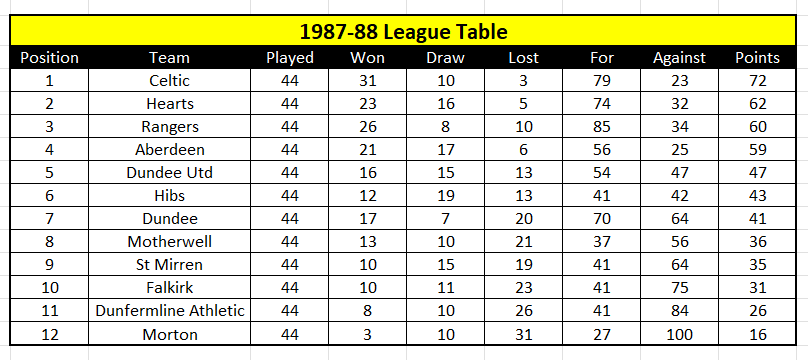
Words by Alistair Aird Having ended a nine-year title famine, the Rangers supporters were hoping to feast on many more triumphs under the stewardship of Graeme Souness. But in season 1987/88 they would face a wounded animal, with Celtic looking to mark their centenary year by reestablishing themselves at the forefront of the Scottish game. And they would do so led by their very own Caesar, Billy McNeill, who had replaced Davie Hay at the helm. Rangers prepared for their own assault on the title with six matches in Switzerland and West Germany. They won four, drew one and lost one, but the defeat would be a chastening one, Souness’s side losing 5-0 against FC Zurich. Signed from Watford, Falco, alongside Graham Roberts, had been part of the Tottenham Hotspur side that won the UEFA Cup in 1984. He was a prolific goalscorer and he was expected to provide competition for the two strikers who had scored the goals that had propelled Rangers to the championship, Ally McCoist and Robert Fleck. Unfortunately, it didn’t work out for Falco at Ibrox. He scored 14 goals in 26 appearances before he joined Queens Park Rangers in December 1987. The United draw was followed by defeats at Easter Road and Pittodrie, and after Falkirk were thumped 4-0 at Ibrox, Souness was dismissed again when Celtic won the season’s first Old Firm game by a goal to nil at Parkhead. After five games, the defending champions had accrued just three points from a possible 10. The ship was steadied with wins over Dundee (2-1), Dunfermline (4-0), Motherwell (1-0) and Morton (7-0). That run featured a couple of McCoist hat tricks to add to the one he had registered in the win over Falkirk. He would go on to have another productive season too, scoring 31 goals in 40 league appearances and a phenomenal 49 in 62 appearances overall. Alas, those goals didn’t prove sufficient to help Rangers retain the championship. A six-game unbeaten run in the league was ended at Tannadice in October. Richard Gough made his debut, but a goal from the former Rangers striker Iain Ferguson was sufficient to secure the points for Dundee United. Gough, who started off playing at right back before moving into central defence, had been much sought after by Souness. But Jim McLean’s belligerence blocked the move, and Gough had a year at Tottenham Hotspur before he eventually became a Rangers player. Gough would score his first goal for Rangers the week after his debut match when Celtic came to Ibrox for the season’s second Old Firm league match. And it would be a somewhat tempestuous affair too. But that match with Aberdeen would feature a season-defining moment. That wasn’t insurmountable, but losing someone as colossal as Butcher wasn’t going to help when it came to trying to bridge the gap. The loss of Butcher saw Gough move into central defence and Scott Nisbet, who had started out as a centre forward, coming in at right back. And the new defensive line-up kept six clean sheets in the next eight league games. Only a single point was dropped in that run, a rather slack performance against Dunfermline Athletic at Ibrox resulting in a 2-2 draw. Among the games played in that period was a 3-2 win over Hearts at Ibrox. Ray Wilkins, bought from Paris Saint Germain for the princely sum of £250,000, made his debut. The recruitment of the experienced Wilkins, a player who could count Chelsea, Manchester United and AC Milan on his CV, was another shrewd piece of business from Souness. Despite signing John Brown, Mark Walters and Ian Ferguson, Rangers dropped points in seven of the 17 league games they played after losing at Parkhead. That resulted in them coming in third, two points behind runners-up Hearts and 12 adrift of Celtic. In total, Rangers lost 10 of their 44 league games. In comparison, Celtic lost only three while Hearts had been beaten on five occasions. The wait for success in the Scottish Cup continued after Rangers were eliminated by Dunfermline Athletic in the Fourth Round. John Brown was ordered off in the 2-0 defeat at East End Park too. The League Cup did however make its way back into the Trophy Room. Wins over Stirling Albion, Dunfermline Athletic, Hearts and Motherwell set up the first of three titanic League Cup Finals against Aberdeen. McCoist was fouled outside the box by Willie Miller, and from the resulting free kick, Cooper scudded a ferocious shot into the top corner with his left foot. Ian Durrant, who was majestic that afternoon, linked up with McCoist to put Rangers 2-1 in front at the break, but goals from John Hewitt and Willie Falconer edged the Dons ahead. But late in the game, a long ball forward was knocked on by Roberts and Robert Fleck pounced to force the match into extra time. The goal would be one of Fleck’s last in a Rangers jersey. He had reportedly become disillusioned with life in the Glasgow goldfish bowl and ended up getting transferred to Norwich City for £580,000. With Mark Falco also departing, Souness was left short of goalscoring options, and although Ally McCoist did what Ally McCoist did – scored a plethora of goals – the loss of Fleck and Falco undoubtedly impacted on Rangers’ quest for silverware. The sides couldn’t be separated in extra time so ‘kicks from the penalty mark’ were required. Among the penalties was one from Trevor Francis that featured a two-step run up and an effort from Aberdeen’s Peter Nicholas that clipped the top of the crossbar. That presented man-of-the-match Durrant with the chance to win the cup, and the man that was arguably the best box-to-box midfielder in the country at the time confidently stroked the ball beyond Jim Leighton. The opening round pitched Souness’s side against Dynamo Kiev. Winners of the Soviet League on 12 occasions, Dynamo had won the European Cup Winners’ Cup twice, with the latter of those being as recent as season 1985/86. They were therefore a formidable opponent, but only a penalty kick from one Alexei Mikhailichenko was all that separated the sides when they took to field at Ibrox for the second leg. That pitch was a somewhat slimline version. Recognising the threat Dynamo posed in the wide areas, Souness instructed the groundsmen to bring the touchlines in. Despite the protestations of the visiting team, the dimensions of the playing surface were still within UEFA regulations and Souness had scored the psychological edge even before a ball was kicked. On what has gone down in folklore as one of the greatest and noisiest nights in Rangers’ European history, goals from Falco and McCoist saw the home side through. All that was left was a final flourish of arrogance from Souness, the Rangers manager deciding in the final minute to wheel round on the halfway line and arc a backpass over the Soviet forwards and back to Chris Woods. The Polish champions, Gornik Zabrze, awaited in round two. The draw conjured up memories of the clash between the two back in season 1969/70, with the 3-1 defeat at Ibrox signalling the end of Davie White’s tenure as Rangers manager. There would be no such trouble this time out. Rangers won the first leg 3-1 – McCoist, Durrant and Falco scored – and a McCoist penalty was enough to earn a 1-1 draw in Poland. This was an era before multiple ties were played and as such, Rangers were now one of only eight teams left vying for Europe’s premier club prize. And when the draw was made for the quarter-final, they were paired with Steaua Bucharest from Romania. The first leg was due to be played in Bucharest in March, but preparations were hampered as new signings Ferguson, Brown and Walters were ineligible. And then there was the injury to Ally McCoist. McCoist had been absent for the last three matches Rangers had played – this broke a remarkable run of 131 successive appearances – and seven days before the tie, he went under the knife to have knee surgery. There seemed to be no chance he would don the number nine jersey, but perhaps influenced by the dearth of striking options due to the respective sales of Fleck and Falco, his return was hastened, and he took his place in the starting XI. Had McCoist been fully fit and at his sharpest, the outcome may have been different, but as it was, Rangers lost 2-0 and faced an uphill battle to make the semi-final. They would give it their best shot at Ibrox, but the concession of an early goal would prove to be a hammer blow. A goal from Gough and a penalty from McCoist had Rangers halfway to the four-goal target by half-time, but the second half yielded no further goals. McCoist could have set up a grandstand finish when presented with a clear chance to score, but he uncharacteristically blazed his shot over the crossbar. After the intoxicating high of winning the title in season 1986/87, the season that followed could conceivably be viewed as a damp squib. It was, however, littered by a series of unfortunate events and in the end, it would become a line in the sand. Over the next decade, Rangers would dominate Scottish football, sweeping aside challenges from not just Celtic but Aberdeen, Hearts and Motherwell too.
The tour would see Mark Falco make his Rangers debut.
After losing out to Porto Allegre in final of the Ibrox International Football Tournament, the league flag was unfurled when Rangers hosted Dundee United in the opening league match of the season. An Ally McCoist penalty earned a 1-1 draw, but the start to the defence of the title was riddled with inconsistency.
The signing of Gough for a £1,000,000 was arguably the best piece of transfer business Souness did during his managerial tenure.
Woods, Butcher and McAvennie were ordered off by referee Jim Duncan, and later ended up in court along with Graham Roberts to answer charges of behaviour that was likely to cause a breach of the peace. In terms of the game itself, Rangers came back from 2-0 down to draw 2-2. McCoist scored the first with a left foot shot and Gough earned a share of the spoils at the death when he lunged in to divert the ball into the net after a cross from Durrant had caused consternation in the Celtic defence.
Three straight league wins followed and three days before a midweek encounter with Aberdeen, there was a 2-2 draw against St Mirren at Love Street.
Terry Butcher, back in the team after missing four matches through suspension, broke his leg and wouldn’t feature again until July 1988. It is true that Rangers had been ragged and inconsistent up to this point, but the gap between themselves and leaders Hearts was only six points after 18 of the 44 scheduled league games.
A 2-0 defeat against Celtic at Parkhead on 2 January saw Souness’s side dropped seven points behind their Old Firm rivals albeit with a game in hand. They had been five points adrift a year earlier with two games in hand and went on to supplant Celtic and win the title, but history wouldn’t repeat itself.
With Chris Woods suspended, Nicky Walker was in goal for Rangers at Hampden, and the man dubbed ‘Shortbread Fingers’ conceded an early penalty when he took down Willie Falconer in the box. Jim Bett scored, but Davie Cooper restored parity with one of the most memorable goals in Rangers’ history.
The season also saw Rangers compete in the European Champions Cup for the first time in nine years. Back then, they had beaten Juventus and PSV Eindhoven before exiting at the hands of Cologne in the last eight. And this campaign would see the Light Blues joust with some European heavyweights once again.
The nine-in-a-row era was about to begin.